
How to Future-Proof Your Website for AI Search
Traditional SEO is not dead, but it is a shrinking channel. The sites winning in 2026 are layering GEO on top of SEO. Here is the data, what changed, and a practical transition plan.
SEO is not dead. But it is not enough.
I want to be direct about this because the "SEO is dead" headline has been recycled every year since 2010 and it has been wrong every time. SEO is not dead. Google still sends traffic. Blue links still get clicks. Your existing SEO work still has value.
But here is what changed: traditional SEO is now a shrinking share of a shrinking pie, and the rate of shrinkage accelerated dramatically in 2025. If your entire search strategy is about ranking higher in traditional results, you are optimizing for a channel that is getting smaller every quarter.
The data that makes this concrete
These are not projections or opinions. These are measured outcomes from 2025:
Organic click-through rates for positions #1 through #5 dropped 17.9% year over year across 200,000+ keywords (GrowthSrc study).
When AI Overviews are present, organic CTR from the top position drops by about 58% (Ahrefs). For informational queries specifically, the drop is 61% (Seer Interactive).
AI Overviews expanded to over 13% of U.S. desktop searches by March 2025, up from 6.5% in January, and that number keeps growing.
Perplexity processes 780 million queries per month. ChatGPT search is growing at 15% month over month.
56% of Google searches end without a click to any external website (SparkToro Q4 2025).
The trend line is clear. Traditional organic clicks are declining and will continue to. The question is what to do about it.
The part nobody talks about: being cited in AI results helps your SEO too
Here is where the narrative gets more interesting than "SEO is dying." According to Seer Interactive’s September 2025 analysis, websites that get cited in AI Overviews receive 35% more organic clicks compared to when they are not cited. Paid click-through rates jump 91%.
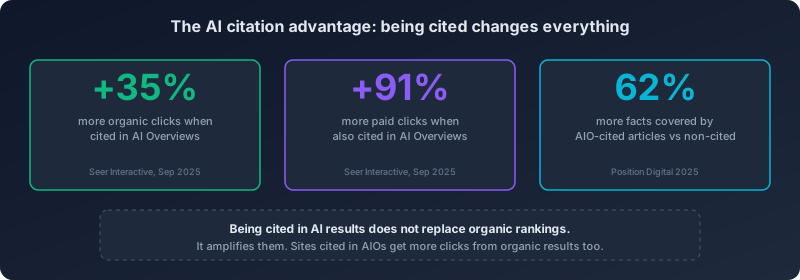
This is the counterintuitive finding that changes the framing entirely. AI citations do not cannibalize your organic traffic. They amplify it. The sites that show up in AI-generated answers also get more clicks on their traditional blue links. The visibility compounds.
A Position Digital analysis found that articles cited in AI Overviews cover 62% more facts than non-cited articles. The core sources for any given topic handle about 42% of the key facts. In other words, AI systems cite the most comprehensive, authoritative sources, and being cited makes you more visible everywhere, not just in AI results.
What "future-proof" actually looks like
Future-proofing is not about guessing which platform will win. It is about building on fundamentals that matter regardless of how search evolves. Those fundamentals have not changed much, but the weight assigned to each one has shifted.
Be the most authoritative source on your topic
This is the one principle that survives every search revolution. Whether the algorithm uses backlinks, brand mentions, AI citation patterns, or something we have not seen yet, the website with the most comprehensive, accurate, expert content on a topic will win. Original research, unique data, expert analysis, hands-on experience. If you are a credible source that other sources reference, you are future-proof.
Make your content machine-readable
Structured data, clean HTML, clear heading hierarchies, server-side rendering. These are not SEO tricks. They are accessibility for machines. And the number of machines that interact with your content, from search crawlers to AI agents to voice assistants, only grows from here. Only 12.4% of websites use Schema.org markup. That gap is an opportunity.
Build brand, not just links
Backlinks still matter (the Semrush 2025 study confirmed a strong correlation between link quality and AI visibility), but AI systems also evaluate trust through brand mentions, reviews, press coverage, social presence, and whether credible independent sources reference your work. A brand that is mentioned consistently across the web carries more authority with AI than a site with great links but no broader presence.
As Concord’s 2025 analysis put it: success is no longer measured only in rankings and clicks but in "whether your brand is cited in AI engines," prioritizing structured content and diversified brand mentions over sole reliance on link-building.
Create content for humans that machines can parse
The irony of the AI era is that genuinely useful human-written content performs better than ever. AI systems are increasingly good at detecting and deprioritizing thin, formulaic, mass-produced content. What wins is content with real expertise, honest assessments, and practical advice, structured in a way that retrieval systems can work with. Question-based headings, self-contained passages, visible dates, named authors with credentials.
The practical transition: what to do this quarter
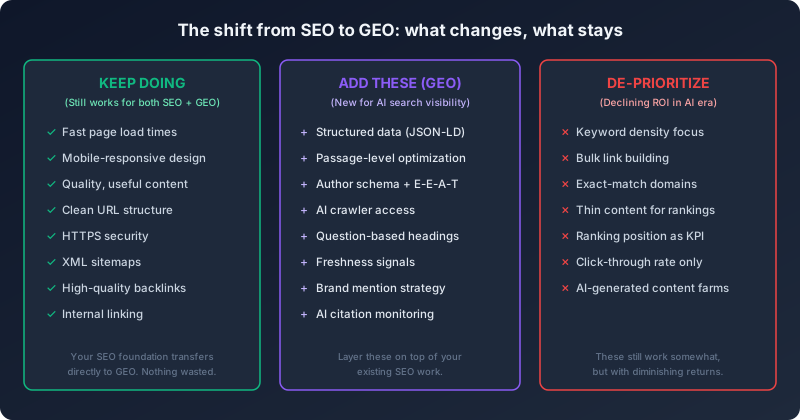
You do not need to abandon SEO. You need to layer GEO on top of it. The good news is that everything you have done for SEO transfers directly: fast sites, quality content, strong links. You are adding to it, not replacing it.
Keep your SEO foundation. Technical SEO, quality content, page speed, internal linking. These still work and they feed into AI ranking signals too.
Add structured data to all content pages. Article schema, Author schema, FAQ schema where relevant. This is the single highest-ROI technical change for AI visibility and only 12.4% of the web does it.
Restructure your top 10 pages for passage-level citation. Question-based headings, direct answers, self-contained paragraphs. Every section should work as a standalone quote.
Start tracking AI citations. Traditional KPIs (rankings, CTR) are not enough. Monitor where and how AI mentions your brand. This is the new metric that matters.
Invest in brand presence. Guest posts, press mentions, reviews, active social profiles. Every independent mention of your brand is a trust signal for AI systems.
The window
GEO in 2026 looks a lot like SEO in 2005. The people who understood search optimization early built advantages that compounded for years. Their competitors spent the next decade catching up.
Right now, the vast majority of websites have not started optimizing for AI search. That will not last. The data is too clear, the traffic shifts too large, and the early mover results too strong to ignore for long.
Start by knowing where you stand. GenReady AI scans your website against the technical, content, and authority factors that AI search systems actually evaluate. One scan, one score, a prioritized list of what to fix. Then you are not guessing. You are working from data.