
The Complete AI Readiness Checklist for Website Owners (2026)
An item-by-item checklist for making your website visible to AI search engines and AI agents. Covers technical setup, content structure, authority signals, and agent readiness, with real benchmarks.
A checklist that actually tells you where you stand
Most "AI readiness" articles give you advice like "create quality content" and "build authority." Helpful in the same way "just be yourself" is helpful on a first date.
Every item in this checklist is something AI search engines and AI agents actually check when deciding whether to cite your content. Go through it section by section, check off what you have, and you'll know exactly what to fix first.
Quick benchmark: fewer than half checked? Your site is probably invisible to AI. Above 80%? You're ahead of almost everyone.
Layer 1: Technical foundation
Most websites fail here. If AI crawlers can't reach your site, nothing else on this list matters. Fix this first.
Crawlability
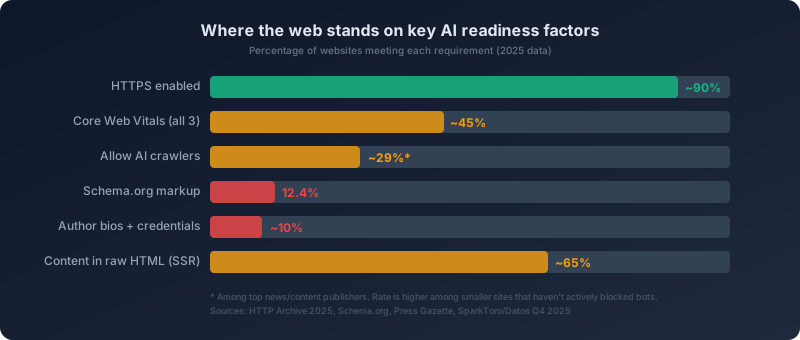
robots.txt allows AI crawlers -- Make sure GPTBot, ClaudeBot, PerplexityBot, and Google-Extended aren't blocked. 79% of major news sites block at least one AI bot. Plenty of smaller sites do it by accident through hosting defaults.
XML sitemap is current and submitted -- AI uses sitemaps to find your content. Stale or missing sitemap? Pages get discovered late, or not at all.
Pages load in under 3 seconds -- Speed matters for AI search the same way it matters for Google. Slow pages get pushed down.
Core Web Vitals pass -- LCP under 2.5s, INP under 200ms, CLS under 0.1. Only about 45% of websites pass all three on desktop, closer to 40% on mobile.
Critical content renders in HTML -- Hit Ctrl+U on your page. If the actual text is in the HTML source, you're fine. If you see empty divs waiting for JavaScript to fill them in, AI crawlers see a blank page. Around 35% of websites have this problem.
No broken links or redirect chains -- Dead ends and redirect loops eat crawl budget and make your site look neglected.
Structured data
Only 12.4% of websites use Schema.org markup. That's wild, because structured data is one of the easiest ways to help AI understand your content. Instead of making it guess what your page is about, you just tell it.
Organization schema on homepage -- Your business name, logo, contact info, social profiles. Tells AI who you are as an entity.
Article schema on content pages -- Headline, author, publish date, last modified date. This is how AI judges whether your content is fresh.
FAQ schema on relevant pages -- Puts your content in the exact question-answer format that AI retrieval loves to grab.
Author schema with credentials -- Connects author names to their expertise, social profiles, and other published work. This feeds straight into E-E-A-T signals.
Breadcrumb schema -- Shows AI how your content is organized and how topics connect to each other.
Product/Offer schema (e-commerce) -- Price, availability, reviews, specs. Without this, AI shopping agents can't compare your products to anyone else's.
All schema validated -- Run it through Google's Rich Results Test. Broken schema is worse than none -- it sends AI the wrong signals.
Security and infrastructure
HTTPS everywhere -- About 90% of websites use HTTPS now. If you're in the other 10%, both browsers and AI flag you as insecure.
WAF/CDN not blocking AI crawlers -- Cloudflare, Akamai, and similar tools sometimes block AI bots by default. Worth checking your firewall and bot management settings.
Mobile responsive design -- AI indexes mobile-first. If your mobile experience is broken, that's the version AI sees.
Clean URL structure -- /blog/ai-readiness-guide reads better than /page?id=4827&cat=3, for both humans and crawlers.
Layer 2: Content quality
So AI can reach your site. Now: is your content worth citing? This is where most of the real competition plays out.
Structure
Clear heading hierarchy (H1, H2, H3) -- AI reads heading structure to figure out what your page is about. Skipped heading levels or headings used purely for styling throw off retrieval.
Question-based H2 headings -- Match how people actually search. "How does AI search decide what to cite?" beats "Citation mechanics" every time.
Key takeaways at top of long content -- A TL;DR or summary near the top gives AI an obvious passage to grab for overview queries.
FAQ sections on relevant pages -- Pre-formatted Q&A is the easiest content type for AI to extract and cite.
Self-contained paragraphs (40-80 words) -- Each paragraph should make sense on its own, without needing the one before it. No "as mentioned above." Every paragraph is a potential citation.
Authority signals
Named authors with bios and credentials -- Sites with clear author expertise rank about 25% higher. Anonymous content gets treated as low-authority, because why wouldn't it?
Data citations with links to sources -- AI checks whether you back up your claims with credible data. Unsourced assertions get ignored.
Original research, case studies, or expert quotes -- Content nobody else has is the most citable kind. If you ran a survey, published data, or interviewed someone with real expertise, that's gold.
Publication and modification dates visible -- Show both on the page and in your Article schema. Hidden dates look suspicious.
No duplicate or thin content -- If three pages on your site say roughly the same thing, AI picks one (or none) and skips the rest.
Freshness
Key pages updated within the last 6 months -- Stale content gets penalized. Quarterly audits are the bare minimum for competitive topics.
Statistics and data points are current -- Citing 2021 numbers in 2026 hurts your credibility with humans and AI alike.
Dead links and outdated references removed -- Broken citations look like nobody's maintaining the page.
Content calendar for regular updates -- Sites that publish and update on a consistent schedule look like active, reliable sources.
Layer 3: Brand and authority
AI doesn't just look at your site. It looks at how the rest of the internet talks about you. A brand that gets mentioned across independent sources -- publications, forums, social media -- carries more weight than one that only exists on its own domain.
Brand mentions across the web -- Industry publications, blogs, forums, social media. Each mention is a trust signal.
Active social media profiles -- You don't need massive followings. You need consistent activity and real engagement.
Reviews on relevant platforms -- Google Business Profile, G2, Trustpilot, industry directories. AI uses review sentiment as a trust signal.
Mentions in industry publications -- Guest posts, expert quotes, press coverage. These are the strongest off-site authority signals you can get.
Business listings in major directories -- Consistent name, address, and phone number across directories helps AI recognize your brand as a real entity in its knowledge graph.
Layer 4: AI agent readiness
This one is newer, but it's arriving fast. As of early 2026, Google's Project Mariner has 574,000 monthly active users browsing the web on their behalf, and Claude Computer Use has 329,000. These agents handle comparisons, bookings, and transactions with a 75% success rate. That number keeps climbing.
Clear navigation that agents can parse -- Semantic HTML, labeled buttons, logical page flow. If a person can figure out your site in 10 seconds, an agent probably can too. If it takes 30 seconds of hunting around, the agent leaves.
API endpoints for programmatic access -- If you offer services that agents might use -- booking, pricing, inventory lookup -- machine-readable endpoints put you on the agentic web.
Natural-language product descriptions -- Agents compare products by reading descriptions. "XR-7 Pro Max 256" means nothing to them. "Noise-canceling wireless headphones with 30-hour battery" does.
Comparison-friendly content -- Clear feature tables or "better than X for Y" framing helps agents (and humans) evaluate you against alternatives.
Pricing and availability clearly stated -- Hide your pricing behind a "contact us" form and AI agents skip you entirely when someone asks "find me the cheapest option."
How to use this checklist
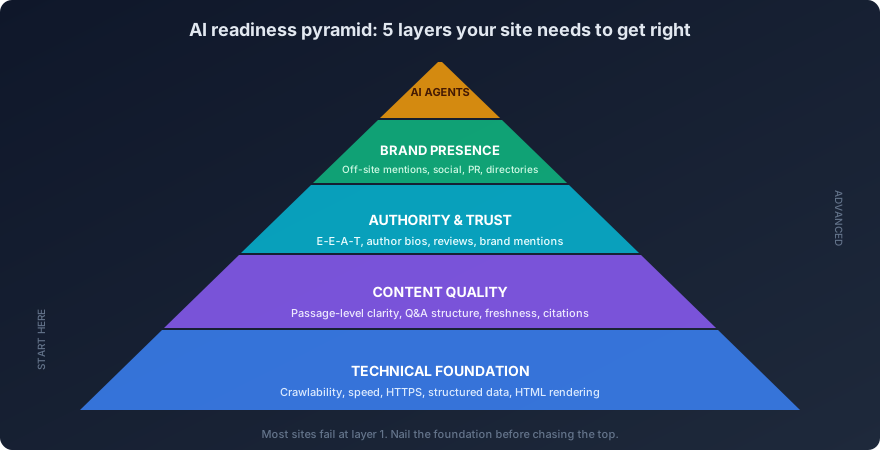
Work top to bottom. There's no point polishing author bios if AI crawlers are blocked by your robots.txt. Technical foundation first, then content, then authority, then agent readiness.
Count your checkmarks:
Under 40%: Your site is likely invisible to AI search. Start with the technical layer today.
40-60%: You have gaps that competitors are already exploiting. Focus on the red items.
60-80%: Solid foundation. Content quality and authority are where you'll pull ahead.
Above 80%: Top 5% of websites. Fine-tune what you have, and start preparing for AI agents.
Want to skip the manual audit? GenReady AI scans your site against these factors and gives you a scored report with prioritized recommendations. Handy if you need something concrete to hand to a dev team.