
40% of Enterprise Apps Will Have AI Agents by Year-End. Is Your Website Ready for Them?
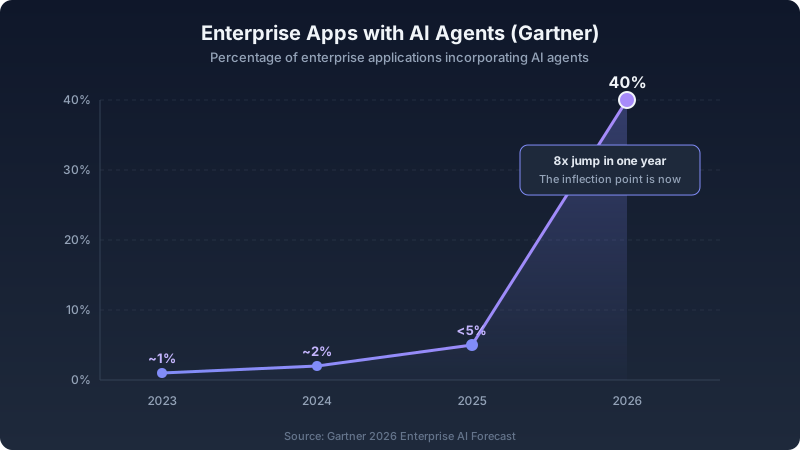
Gartner forecasts 40% of enterprise applications will incorporate AI agents by December 2026, up from under 5% in 2025. The agentic AI market passes $10.9 billion. Here's what the multi-agent wave means for your website and how to prepare.
The money trail
Gartner's latest forecast says that by December 2026, 40% of enterprise applications will have AI agents baked in. Last year it was under 5%. That's an 8x jump in twelve months.
I keep coming back to what that actually means for anyone running a website. Because those agents don't stay inside corporate firewalls. They browse. They crawl. They compare. And they're about to show up on your site in numbers that would have seemed absurd two years ago.
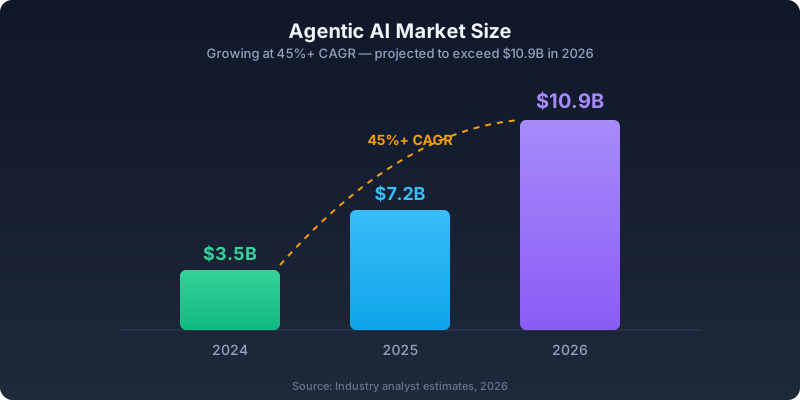
The agentic AI market is on track to pass $10.9 billion this year, growing at 45%+ annually. Jensen Huang called enterprise agent adoption "skyrocketing" during Nvidia's earnings call last week, where the company posted $68.1 billion in quarterly revenue. Most of that came from data center hardware powering these systems.
Deloitte found that 54% of companies expect to move at least 40% of their AI experiments into production within six months. A year ago, that number was 25%.
Real money. Real deployment timelines. And every one of those deployed agents needs to interact with the web.
Where the agents actually are
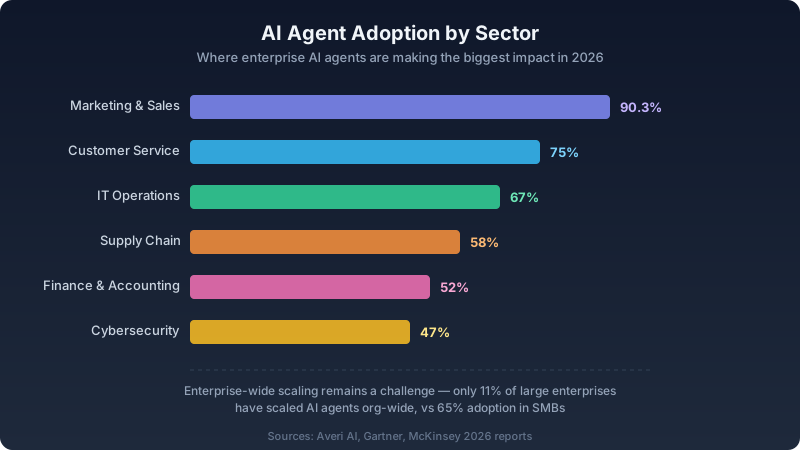
Marketing and sales are furthest along — over 90% of organizations already use AI agents in their marketing stack. Customer service sits around 75%. IT ops, supply chain, finance, cybersecurity are all embedding agents into daily workflows.
The part that matters for website owners: these agents don't sit behind a dashboard. They go out and browse vendor sites, compare pricing, read documentation, pull reviews, hit APIs and MCP endpoints.
One user asking "find me the best CRM for a 50-person company" can kick off an orchestrator that sends three or four sub-agents out at once. One researches features by crawling vendor sites. Another compares pricing pages. A third pulls reviews from multiple sources.
Your website just went from one human visitor to a small swarm of machines. Each one needs to extract structured, accurate information from your pages in seconds.
The weird scaling gap
Here's what I find interesting. While 90%+ of marketing teams use agents, only 11% of large enterprises have scaled AI across their whole organization. SMBs are ahead at 65%.
That gap won't last. Gartner's 40% number covers enterprise applications broadly, not just marketing. When finance teams deploy agents that check vendor pricing, when supply chain systems evaluate supplier websites, when security agents audit third-party services — every business website becomes a target for automated interaction.
There's a paradox here: the companies rolling out these agents are the same companies whose own websites aren't ready to receive them.
What multi-agent traffic actually looks like
Traditional web traffic: one person, one browser, one page at a time. Multi-agent traffic works differently.
An orchestrator gets a complex query and splits it into sub-tasks. Each sub-task goes to a specialized agent. The research agent crawls your site for product info. The pricing agent looks for structured pricing data. The review agent checks testimonials and third-party mentions.

These agents don't browse like people. They don't scroll through your homepage, click navigation menus, or read hero banners. They parse structured data, clean HTML, and machine-readable content. Find it, and you get cited in the final answer. Don't have it, and they move to a competitor who makes extraction easier.
This is GEO at scale. Generative Engine Optimization used to mean "get cited by ChatGPT." When 40% of enterprise apps run their own agents, GEO means being machine-readable for thousands of different AI systems, not just the big search engines.
New jobs are showing up
The agent wave is creating job titles that didn't exist a year ago. AgentOps managers oversee fleets of AI agents the way DevOps teams manage servers. AI supervisors monitor agent behavior and step in when things break.
What this tells website owners: the companies visiting your site are getting more sophisticated about AI. They expect their agents to work with your content. A site that blocks AI crawlers, renders everything in JavaScript, or buries key information in walls of text isn't just losing search traffic. It's failing business-critical interactions that happen to be automated.
What to do about it
The 40% forecast means the preparation window is shrinking. Five things make your website agent-ready:
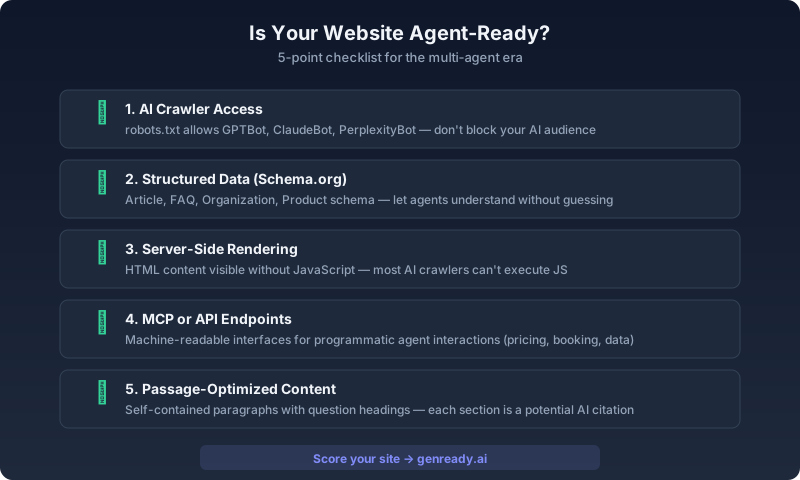
Allow AI crawlers. Check your robots.txt. GPTBot, ClaudeBot, PerplexityBot should be permitted. Blocking them blocks revenue.
Add structured data. Schema.org markup (Article, FAQ, Organization, Product) gives agents labeled data instead of guesswork.
Serve real HTML. Most AI agents can't run JavaScript. If your content only renders client-side, agents see a blank page and leave.
Expose machine interfaces. An MCP endpoint or API lets agents interact with your product programmatically. That's the difference between being browsed and being integrated.
Write in passages. Questions as headings, direct answers below, self-contained paragraphs. Each section is either a citation or a missed opportunity.
Where this is heading
Gartner says 40% of apps will have agents by December. The market passes $10.9 billion. Companies are hiring people specifically to manage agent fleets.
For anyone with a website, the takeaway is simple: AI traffic is about to scale hard, and it won't just come from ChatGPT and Perplexity. It'll come from thousands of enterprise applications, each running agents that need to read, understand, and interact with your content.
Sites built for this — clean HTML, structured data, machine interfaces, passage-optimized content — will get a disproportionate share of citations, recommendations, and transactions. Everyone else will watch their competitors show up in AI answers and wonder what happened.
Want to know how agent-ready your website is? Try GenReady AI — it scans your site's structured data, content structure, and AI accessibility in under 60 seconds.