
Why Your Website Traffic Is Declining (And It's Not What You Think)
Website owners are seeing unexplained traffic drops of 15-38%. The cause is not a Google penalty. It is AI search answering queries before users click. Here is the data, and what to do about it.
Your analytics are not telling you the full story
Pull up your Google Analytics. Organic traffic is down somewhere between 10% and 30% year over year. You have not changed anything. No Google penalty. No technical disaster. Rankings look about the same.
The instinct is to blame an algorithm update or seasonal trends, but the explanation is simpler and harder to fix: a growing share of the searches that used to drive traffic to your site now get answered before anyone clicks a link.
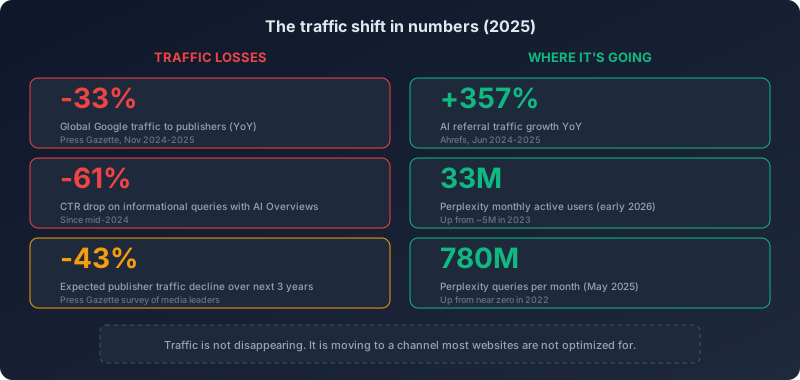
According to Similarweb data, organic search traffic across the top 40,000 U.S. websites declined 2.5% year over year in 2025. That sounds small, but it is an average that hides enormous variation. Press Gazette found that Google traffic to publishers dropped 33% globally and 38% in the U.S. alone between November 2024 and November 2025. Some individual sites lost 40%.
Where the traffic actually went
The traffic did not go to a competitor’s website. It went to AI-generated answers. The user asked a question, got a synthesized response with citations, and moved on without clicking any link at all.
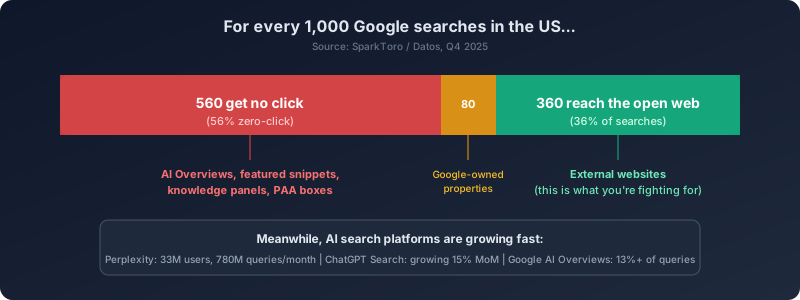
SparkToro’s Q4 2025 report puts it plainly: for every 1,000 Google searches in the U.S., only 360 clicks reach the open web. The other 640 either result in no click at all or land on a Google-owned property. Rand Fishkin describes the current state as a "Zero-Click World" where marketing is "stuck vying for the meager, shrinking scraps of traffic" that search engines still send.
And it is not just Google. Users are starting their searches on platforms that did not exist three years ago:
Perplexity has 33 million monthly active users and processed 780 million queries in a single month (May 2025), up from nearly zero in 2022.
ChatGPT with web search has been growing at roughly 15% month over month.
Google AI Overviews expanded to over 13% of U.S. desktop searches by March 2025, up from 6.5% in January. When they appear, organic click-through rates from the top position drop by about 34%.
Copilot is built into Windows and Edge, intercepting searches before they reach a browser tab.
Who is getting cited instead of you?
The websites that do show up in AI-generated answers share a consistent set of traits. After looking at citation patterns across Perplexity, ChatGPT, and Google AI Overviews, the pattern is clear:
Structured data markup on content pages (Article schema, FAQ schema, Author schema)
Named authors with verifiable credentials and expertise
Recently published or recently updated content with visible dates
Clear, passage-level content where each section answers a specific question directly
Brand presence across multiple independent sources (reviews, press mentions, social profiles, directory listings)
A Yext study found that 86% of AI citations come from brand-managed sources. That means the websites getting cited are not just passively getting picked up by AI. They are actively managing their digital presence in a way that makes them easy for AI to find, evaluate, and trust.
Notice what is not on the list: keyword density, exact-match domains, backlink volume, domain age. The factors that dominated traditional SEO matter less when AI systems evaluate source quality holistically rather than through a link graph.
This is fixable, but the window matters
The uncomfortable truth in the data: media leaders surveyed by Press Gazette expect traffic to decline by an average of 43% over the next three years. One-fifth anticipate losses exceeding 75%. Most are already reducing effort on traditional Google search optimization.
That is the pessimistic framing. The optimistic framing is that AI referral traffic grew 357% year over year and visitors from AI search convert 27% better than traditional search visitors. The traffic is not disappearing. It is moving to a different channel, and most websites have not started optimizing for it.
The sites that figure out AI search optimization in 2026 are in a position similar to those that figured out SEO in 2005. The competition is thin and the advantage of moving early compounds over time.
Five things to do this week
You do not need a six-month strategy to start. These five actions take a few hours total and address the most common reasons websites are invisible to AI search:
Check your robots.txt. Search for GPTBot, ClaudeBot, PerplexityBot. If they are blocked, remove those lines. 79% of major news sites block at least one AI bot, many without realizing it.
Add Article and Author schema to your top 10 pages. Include
dateModifiedand real author credentials. Only 12.4% of websites have any Schema.org markup at all.Update your most important content. Refresh statistics, add 2026 context, change the modification date. AI systems prefer newer content aggressively.
Restructure one key article for AI citation. Question-based headings, direct answers in the first paragraph of each section, self-contained paragraphs that work as standalone quotes.
Audit your AI visibility. Run your site through GenReady AI to see where you stand. The scan checks technical, content, and authority factors and gives you a prioritized action list.
The gap between websites that are optimized for AI search and those that are not will only widen from here. The question is which side you are on when AI handles the majority of search queries, because that is where this is headed.