

65% of Google Searches Now End Without a Click. Here's How to Stop Bleeding Traffic.
Two out of three Google searches end without a click to any website. AI Overviews trigger on 32-40% of US searches, and the zero-click rate is projected to hit 70% by year-end. The shift from ranking to citation changes everything for website owners.
Two out of three people who search on Google never click through to any website. That number was 42% in 2024. It hit 59% in 2025. As of Q1 2026, SparkToro puts it at 65%, and Gartner projects 70% by year-end.
The cause isn't mysterious. Google's AI Overviews now trigger on 32-40% of US searches. Add Perplexity with 150 million monthly users, ChatGPT Search with 900 million weekly users, and a dozen other answer engines, and you get a web where the answer lives on the search page, not on your site.
I've been watching this unfold for months. The data is now clear enough that I think every website owner needs to see it and decide what to do about it.
The numbers that matter
AI Overviews appeared on about 15% of US searches in mid-2024. That doubled to 30%+ by early 2026. On informational queries, the trigger rate is even higher.
The query types getting hit hardest tell you exactly where the damage is concentrated:
How-to queries: 84% zero-click
"What is" queries: 78% zero-click
Informational: 60% zero-click
Product/review: 45% zero-click
Local searches: 32% zero-click
Navigational (brand searches): Only 12% zero-click

If your website depends on informational traffic, the how-to guides, the explainers, the "complete guide to X" posts, that's where the bleeding is worst. Those queries are being answered directly by AI, and users have no reason to click through.
Who's losing and who's surviving
Not every site loses equally. The year-over-year traffic data from Similarweb, Ahrefs, and BrightEdge shows a clear pattern.
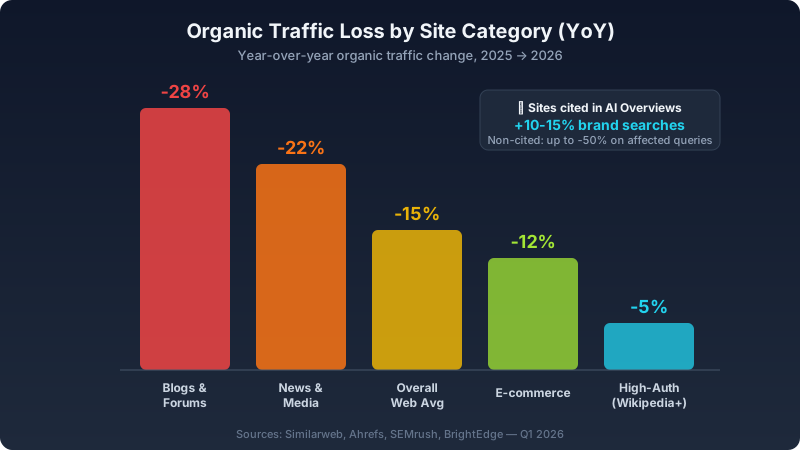
Blogs and forums took the biggest hit at -28% organic traffic year-over-year. News and media sites dropped 22%. E-commerce fell 12%, less severe because product queries still drive clicks. The overall web average sits at -15%.
But here's the part that changes the calculus: high-authority sites with strong structured data, think Wikipedia, Mayo Clinic, sites that are consistently cited as sources, lost only about 5%. Some of them actually gained brand search traffic because being cited in AI answers drives recognition.
The SEMrush data backs this up. Sites quoted in AI Overviews see 10-15% more branded searches. Non-cited sites lose 30-50% of traffic on queries where AI Overviews appear.
The divide isn't between big sites and small sites. It's between sites that AI systems cite as sources and sites that AI systems replace.
Why this is accelerating now
This week alone, OpenAI rolled out GPT-5.3 Instant as ChatGPT's new default model, focused on more natural conversations and fewer refusals. Google launched Gemini 3.1 Flash-Lite for cheap, high-volume workloads. xAI filed for a $659 million expansion of its Colossus 2 data center.
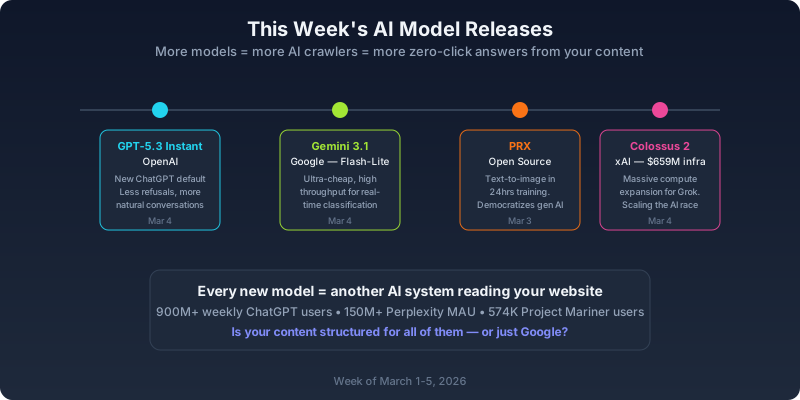
Each of these means more AI-generated answers, served faster and cheaper, to more users. GPT-5.3 Instant being less cautious means it'll answer more queries directly instead of hedging and sending users to sources. Gemini Flash-Lite being dirt-cheap means Google can run AI Overviews on even more searches without the economics breaking.
Look at the infrastructure money. OpenAI's $110 billion raise. xAI's $659 million data center expansion. Google putting Flash-Lite into production. All of it funds one thing: more AI answers, fewer clicks to your website.
And users want this. A SurveyMonkey study found 52% of users "rarely or never" click through to websites after getting an AI answer. Among 18-34 year olds, that number is 68%. They prefer the on-page answer. This isn't going to reverse.
The citation economy
Here's what I keep coming back to. The web isn't dying. Traffic patterns are shifting. The old model was: user searches, clicks your link, reads your page. The new model is: user searches, AI reads your page, AI synthesizes an answer, maybe cites you.
In the old model, you needed to rank. In the new model, you need to be cited.
That's a different optimization problem entirely. Ranking was about keywords, backlinks, and domain authority. Citation is about being the source AI pulls from when it answers a question.
The Wharton GEO research found that adding statistics to your content increases AI citation rates by 28%. Schema.org markup increases extraction reliability by 2.5x. Content that reads like a reference, with clear attributions, specific data, and expert credentials, gets cited more.
This is why I built GenReady. The shift from ranking to citation requires a different kind of website analysis. You need to know whether your structured data is complete, whether your content is passage-optimized for AI extraction, whether your pages are even visible to AI crawlers.
What to actually do
I've been advising clients and talking to web developers about this shift for months. Here's what works.

1. Get cited, not clicked. Structure every important page so AI can extract a clean, citable passage. Question as heading, direct answer in the first sentence, supporting data below. Treat each section as a standalone snippet that could appear in an AI answer with your site name next to it.
2. Schema markup everything. FAQPage, HowTo, Article, Product, Author schema. Every page should tell AI systems exactly what the content is, who wrote it, and why they're qualified. Sites with comprehensive schema markup get cited 2.5x more than those without, and only 12.4% of sites currently implement it. That's your competitive advantage right there.
3. Own your brand searches. Zero-click destroys generic queries, not branded ones. Only 12% of navigational searches end without a click. When someone searches your brand name, they click through. So build brand recognition. Publish original research. Get cited as a source. When AI mentions your brand in answers, people come find you directly.
4. Expose machine interfaces. MCP endpoints and APIs let AI agents interact with your product, not just read about it. When a shopping agent can query your inventory programmatically, you're not competing for a citation, you're completing a transaction. The agentic web is where this heads next.
5. Diversify beyond search. YouTube traffic is up 18%. Newsletter subscribers and community members don't come through Google. Sites that depend on organic search alone are the most exposed to the zero-click shift. Build direct relationships with your audience.
Where this leaves us
Ranking on page one used to mean traffic. That connection is breaking. AI Overviews, Perplexity, ChatGPT Search — they're absorbing the informational layer of the web. The clicks that remain go to branded queries, product transactions, and sites that AI cites as sources.
You can't fight this. Google built AI Overviews because users prefer them. 65% zero-click exists because people get what they need without clicking.
What you can do is become the source AI references. Structure your content for citation. Add structured data so AI understands your pages. Build brand recognition so people search for you directly. Expose machine interfaces so AI agents can transact with you, not just read about you.
The websites that do well in 2026 won't be the ones with the best SEO. They'll be the ones AI trusts enough to cite.
Want to know how citation-ready your website is? Try GenReady AI — it analyzes your structured data, content structure, and AI accessibility in under 60 seconds.