
AIO vs GEO vs AEO: Which AI Optimization Strategy Does Your Website Need?
AIO, GEO, AEO, LLMO — the jargon keeps multiplying. Here's what each term actually means, where they overlap (a lot), and which strategy deserves your time based on real data.
Too many acronyms, not enough clarity
If you work in digital marketing, you've probably had this experience in the last year: someone drops "GEO" in a meeting, someone else says "AEO," a third person mentions "AIO," and everyone nods like they know what's happening. Nobody does.
I counted at least six different acronyms for variations of "make your website work with AI" in a single week of industry newsletters. The terminology is a mess. But the underlying shift is real, and it matters whether you're a solo blogger or running a Fortune 500 site.
Here's what each term actually means, where they overlap, and which one deserves your attention.
AEO: answer engine optimization
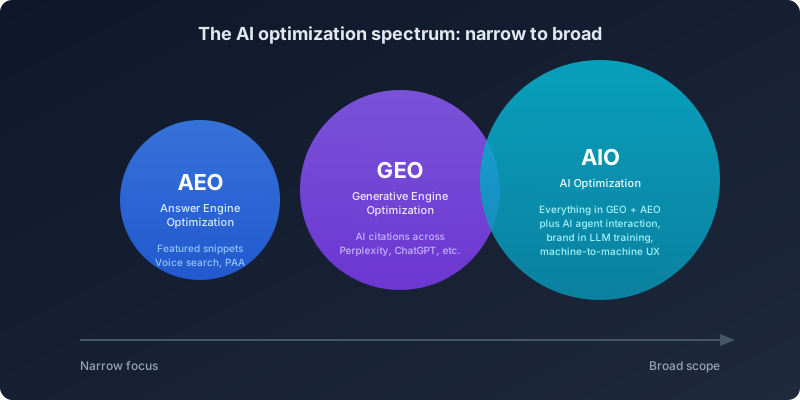
AEO is the oldest of the three. It started around 2015 when Google introduced featured snippets, and it's about getting your content picked as the direct answer to a query. Featured snippets, voice assistant responses, the "People Also Ask" boxes, position zero results.
The playbook is straightforward:
Structure content as clear question-then-answer pairs
Keep the direct answer short (40-60 words), then expand below
Add FAQ schema markup so machines can parse the Q&A structure
Target "what is," "how to," and "best way to" queries
AEO works well for content-heavy sites, knowledge bases, and how-to publishers. If you publish answers to questions people actually ask, AEO is table stakes.
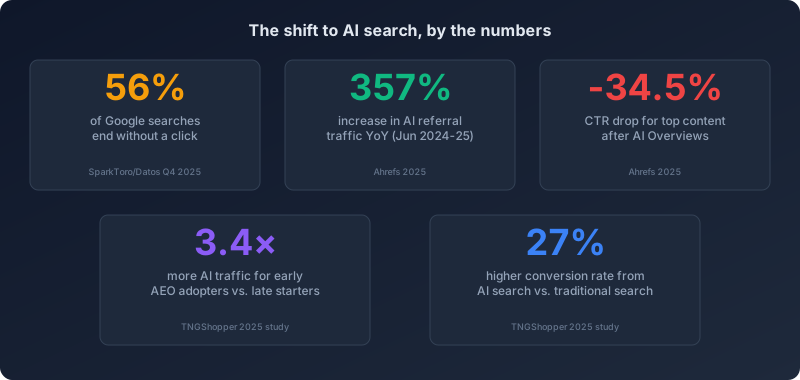
Early adopters who started AEO work in early 2024 are now seeing 3.4 times more answer engine traffic than competitors who waited, according to a 2025 study by TNGShopper. That's a wide gap for a one-year head start.
GEO: generative engine optimization
GEO showed up as a concept in 2023 and has become the dominant term in 2025-2026. It's broader than AEO: instead of targeting one answer box, you're trying to become a cited source across AI-generated responses on Perplexity, ChatGPT, Google AI Overviews, Claude, and Copilot.
The difference from AEO is subtle but important. AEO optimizes for a single slot ("be the featured snippet"). GEO optimizes your entire web presence so that any passage on your site can be pulled into any AI-generated answer.
What GEO involves:
Passage-level optimization, where every paragraph works as a standalone, citable unit
Strong E-E-A-T signals: named authors, credentials, data citations
Structured data across all content pages
Cross-platform brand authority (mentions, reviews, social proof)
The stakes are high. Ahrefs found that AI Overviews reduced click-through rates for top-ranking Google content by 34.5% in just one year. At the same time, AI referrals to top websites surged 357% year-over-year between June 2024 and June 2025. Traffic isn't disappearing. It's moving to a different channel, and GEO is how you show up there.
AIO: AI optimization
AIO is the broadest term. It covers everything GEO and AEO handle, plus a layer that most businesses haven't thought about yet: making your site work with AI agents that do things, not just answer questions.
Think about what's coming (and in some cases, already here):
AI shopping agents that compare prices and place orders
AI travel agents that book flights and hotels on your behalf
AI assistants that fill out forms, schedule appointments, and navigate websites without human input
AIO includes GEO and AEO work, but adds:
Making your site navigable by autonomous AI agents
Ensuring LLMs have accurate information about your brand in their training data
Providing API endpoints or machine-readable interfaces for programmatic access
Natural-language product descriptions that agents can parse and compare
If you run an e-commerce store, a SaaS product, or any service where an AI agent might interact with your site on behalf of a user, AIO is where you'll end up. The timeline is less urgent than GEO, but the companies thinking about it now will have a structural advantage.
LLMO: the one you can mostly ignore
Large Language Model Optimization (LLMO) targets how models like ChatGPT and Claude perceive your brand based on their training data. It's essentially brand reputation management for AI.
In practice, if you do GEO well, LLMO takes care of itself. The same signals that make AI search engines cite you (authority, accuracy, consistency) also shape how LLMs talk about your brand. I wouldn't treat LLMO as a separate workstream unless you have a specific brand perception problem in AI responses.
They overlap more than they differ
Here's what I think gets lost in the acronym wars: about 80% of the work is the same regardless of which label you use.
"ChatGPT users don't abandon Google Search; using generative AI actually expands overall search behavior." — Jasper AI research, 2025
That finding matters because it means you don't have to pick sides. The foundations are shared:
Technical accessibility: structured data, clean HTML, fast loading, AI crawler access
Content quality: authoritative, well-structured, passage-level clarity
Brand authority: consistent presence across the web, expertise signals, reviews
Freshness: regular updates, current data, visible modification dates
Do those four things well and you're covered for AEO, GEO, and most of AIO.
Where to start if you're overwhelmed
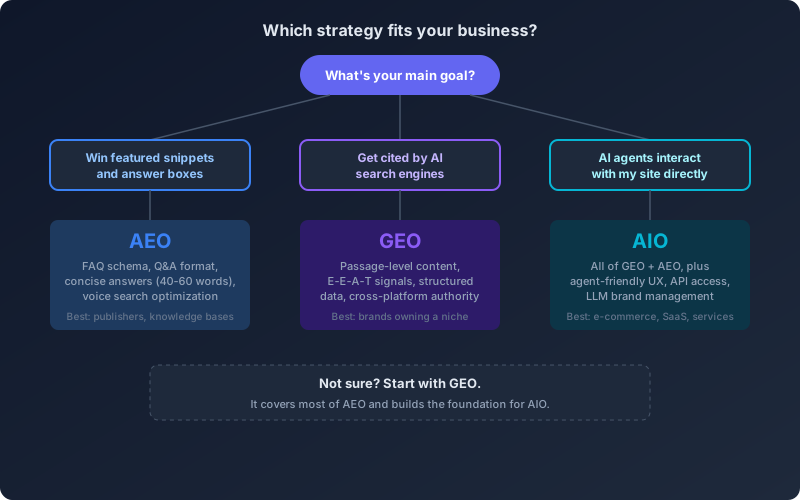
Start with GEO. It's the middle ground that covers most of what AEO does while building the foundation for AIO when you're ready.
Rand Fishkin of SparkToro put it bluntly: marketing is "stuck vying for the meager, shrinking scraps of traffic" that search engines still send. With 56% of Google searches ending without a click (per SparkToro's Q4 2025 report), optimizing only for traditional rankings means fighting for a smaller slice every quarter.
The good news: visitors who do come through AI search convert 27% better than traditional search visitors. Fewer clicks, but higher quality.
Run your site through GenReady AI to see where you stand across all these dimensions. One scan, one score, specific recommendations. No acronym expertise required.