
Chinese AI Models Just Overtook American Ones in Usage. Here's Why That Matters for Your Website.
OpenRouter data shows Chinese models consumed 5.16 trillion tokens last week vs 2.7 trillion for US models — driven by 16x cheaper pricing. What this means for web developers: more diverse AI traffic, the growing importance of structured data, and why MCP integration matters now.
For the first time, Chinese AI models are being used more than American ones globally. Not in China. Worldwide. By developers who are mostly based in the US and Europe. I've been tracking this shift for months, and the latest OpenRouter data finally makes it undeniable.
The numbers
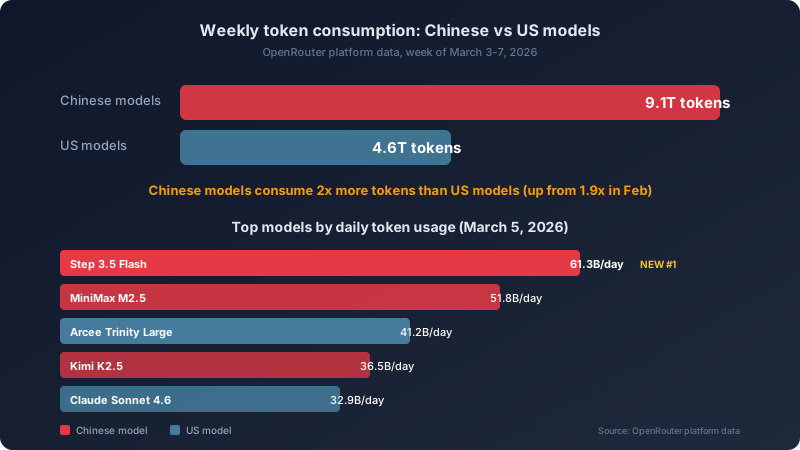
OpenRouter, one of the largest AI model routing platforms, shows the gap widening. In the week of March 3-7, 2026, Chinese models consumed 9.1 trillion tokens. US models: 4.6 trillion. That's 2x — up from 1.9x just two weeks earlier.
The top models driving this: Step 3.5 Flash from StepFun hit #1 on March 5 with 61.3 billion tokens in a single day. MiniMax M2.5 remains the cumulative all-time leader. Moonshot AI's Kimi K2.5 holds strong in fourth place. Three Chinese models now occupy the top five spots — with only Arcee Trinity and Claude Sonnet 4.6 representing the US.
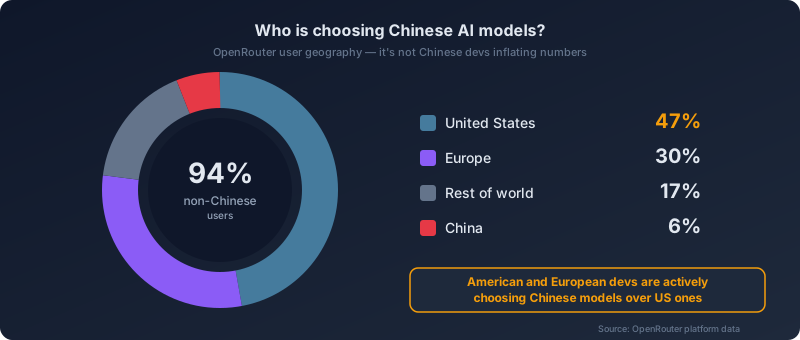
The part that caught my attention: only 6% of OpenRouter's users are in China. 47% are in the US. So it's not Chinese developers inflating their own models' numbers. American and European devs are actively choosing Chinese models.
Why developers are switching: it's the price
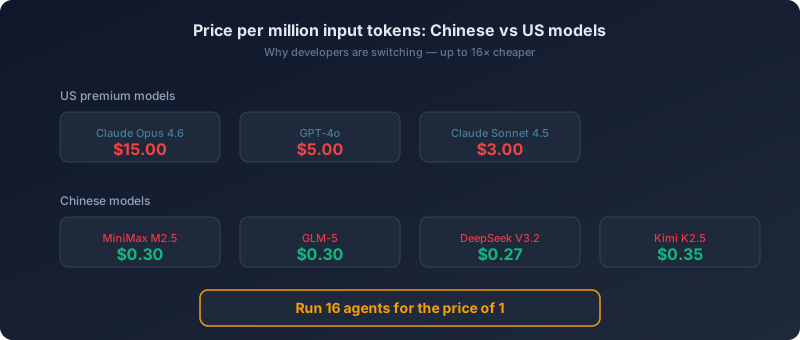
The reason is straightforward: cost. MiniMax M2.5 and GLM-5 charge about $0.30 per million input tokens. Claude Opus 4.6 charges $5 for the same amount. That's roughly 16 times cheaper.
The reason is straightforward: cost. MiniMax M2.5 and GLM-5 charge about $0.30 per million input tokens. Claude Opus 4.6 charges $5 for the same amount. That's roughly 16 times cheaper.
5 per million tokens while Chinese models charge $0.27-$0.35 — up to 16x cheaper" />
For a developer running an AI agent that processes thousands of requests per day, that price difference changes the math completely. You can run 16 agents on a Chinese model for the price of one on a top US model. Or you can run the same agent and keep 94% of the budget.
This isn't about quality differences disappearing. Claude, GPT, and Gemini still lead on complex reasoning and enterprise work where accuracy matters. But for the bread-and-butter stuff, coding assistance, content processing, data extraction, running automated agents, the Chinese models are good enough. And "good enough at 1/16th the price" wins every time.
What this means for websites and content
OK, so Chinese models are cheap and popular. Why should you care if you run a website or create content?
Because the AI models consuming your website, crawling your pages, summarizing your articles for users, are increasingly going to be these cheaper, high-volume Chinese models. That changes a few things.
First, if you've been optimizing content for how ChatGPT or Claude interprets it, you now need to think about MiniMax, Kimi, DeepSeek, and GLM too. Each model has different strengths and blind spots. I tested the same product page across five models last week and got noticeably different summaries. Content that reads clearly to one can confuse another.
Second, when running an AI agent costs 16x less, people run more agents. Simple economics. Expect more automated visitors to your site, more AI-generated summaries of your pages appearing in search results and chat interfaces. This is the AEO (Answer Engine Optimization) reality: your content needs to be structured so that any AI model can extract accurate answers from it, not just the ones you've tested against.
Third, structured data matters more than ever. Chinese models are trained on slightly different data distributions than American ones. They tend to parse schema markup, clear headings, and FAQ sections more reliably than they interpret nuanced prose. If you've been putting off structured data work, this is a good reason to stop procrastinating.
And then there's MCP. The Model Context Protocol lets AI agents interact directly with web services. As agent costs drop, more services will expose MCP endpoints, and more agents will use them. If your business has an API or could benefit from AI agents accessing it programmatically, an MCP integration is worth planning for now rather than later.
The bigger picture: a two-tier AI world
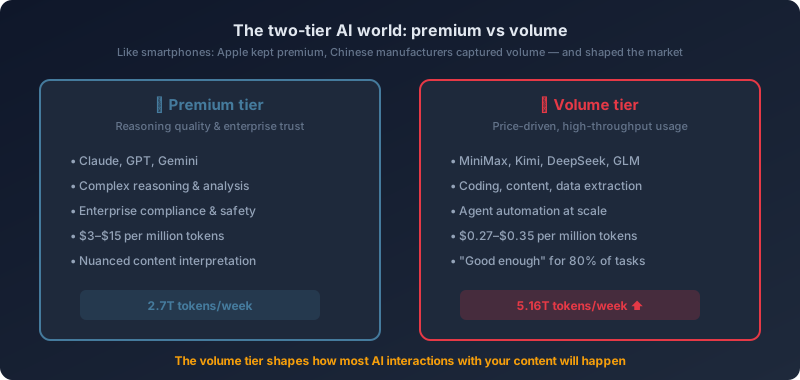
AI usage is splitting into two markets. A premium tier where American and European models compete on reasoning quality and enterprise trust. A volume tier where Chinese models win on price.
AI usage is splitting into two markets. A premium tier where American and European models compete on reasoning quality and enterprise trust. A volume tier where Chinese models win on price.
5) vs volume tier (MiniMax, Kimi, DeepSeek at $0.27-$0.35) — volume tier now dominates usage" />
I keep thinking about smartphones. Apple kept the premium segment, Chinese manufacturers captured the volume market, and the volume players ended up shaping how most of the world experienced mobile technology. We're watching the same thing happen with AI models right now.
For the web, this means the "average" AI interaction with your content will come from a cheaper, faster model that prioritizes throughput over nuance. Clear, well-structured, factually precise content will do fine regardless of which model processes it. Content that relies on subtle context or cultural references might get flattened into something unrecognizable.
What to do about it
If you're a web developer or content creator, here's what I'd actually do:
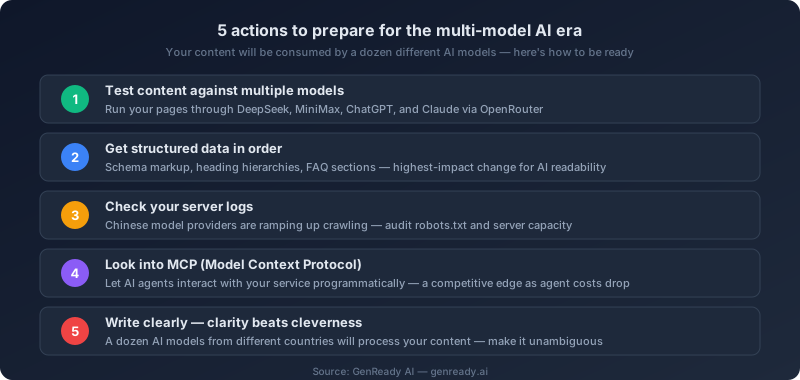
Test your content against multiple models. Don't just check ChatGPT. Throw your pages at DeepSeek, MiniMax, and others through OpenRouter. Do they extract the same key info? You might be surprised.
Get your structured data in order. Schema markup, clear heading hierarchies, FAQ sections, explicit metadata. This is the single highest-impact thing you can do for AI readability, and it helps traditional SEO too.
Check your server logs. Chinese model providers are ramping up crawling. Make sure your robots.txt and server capacity can handle the new traffic patterns.
Look into MCP. If you have a product or service that AI agents might want to access programmatically, an MCP endpoint could put you ahead of competitors still thinking only about traditional search.
Write clearly. When your content might be processed by a dozen different AI models from different countries, clarity beats cleverness.
The Chinese model surge isn't going away. The cost advantages are structural, the quality gap is narrowing with every release, and developers follow the economics. The web is about to get a lot more AI traffic from a lot more models. I'd rather be ready for that than surprised by it.