
How AI Search Engines Actually Work (And Why Your SEO Strategy Needs to Change)
A plain-English explanation of how Perplexity, ChatGPT, and Google AI Overviews decide which websites to cite. With real data on citation patterns and a practical framework for optimization.
You are optimizing for a system you probably do not understand
Traditional SEO had a simple mental model: Google crawls your page, indexes it, ranks it by relevance and backlinks. Write the right keywords, build links, and you show up. The system was complicated in practice, but the concept was clear.
AI search works differently at a fundamental level, and most website owners are still applying SEO intuitions to a system that does not work that way. That leads to wasted effort on tactics that no longer move the needle and neglect of things that actually matter.
This article explains the mechanics. Once you understand how AI search finds, evaluates, and uses your content, the optimization strategy becomes obvious.
What is RAG and why should you care?
Modern AI search tools (Perplexity, ChatGPT with web access, Google AI Overviews, Gemini, Copilot) all use some version of a process called Retrieval-Augmented Generation, or RAG. The name sounds technical but the concept is straightforward: instead of answering from memory, the AI searches the web first, finds relevant content, and then writes an answer based on what it found.
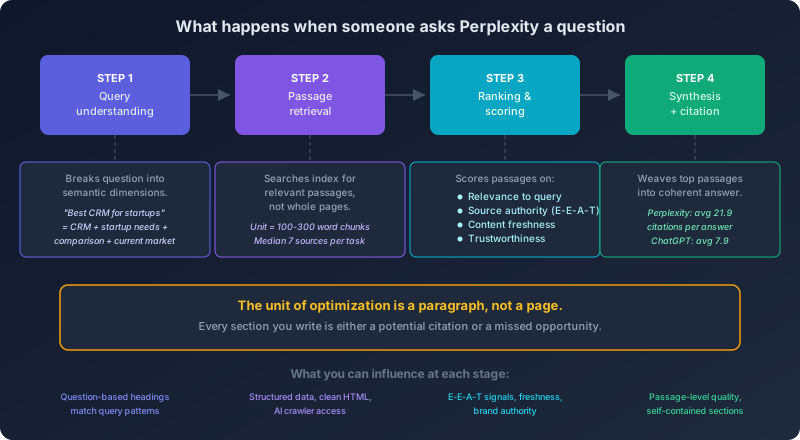
Here is what happens, step by step, when someone types a question into Perplexity:
Step 1: The AI breaks down the question
A question like "What is the best CRM for a 10-person startup?" gets decomposed into semantic dimensions: CRM software, small team requirements, pricing considerations, current market options, user reviews. The AI does not search for the exact phrase. It searches for content that covers these dimensions.
Step 2: It retrieves passages, not pages
This is the single most important thing to understand. The system searches its index for relevant passages, typically chunks of 100-300 words. It does not look at your page as a unit. It looks at individual paragraphs, sections, and answer blocks. A 3,000-word article might have 15 retrievable passages, each evaluated independently.
Research on agentic AI systems shows they typically rely on a median of 7 sources per task, ranging from 3 to 15 depending on complexity. Your passage is competing for one of those slots.
Step 3: It scores and ranks those passages
Retrieved passages get scored on several factors:
Relevance to the specific question being asked
Source authority, measured through E-E-A-T signals, domain reputation, and author credentials
Freshness, with strong preference for recently published or updated content
Trustworthiness, based on data citations, consistency with other sources, and structured data markup
A 2025 Semrush study found that authority score, driven by backlink quality and referring domain diversity, has the strongest correlation with AI citation share of voice (Pearson correlation: 0.65). Quality still beats quantity, but the signals AI systems use to measure quality are broader than traditional PageRank.
Step 4: It synthesizes an answer and cites its sources
The AI generates a coherent response by combining information from the top-ranked passages. It does not copy-paste. It synthesizes, summarizes, and connects ideas, then attributes information to the sources it used.
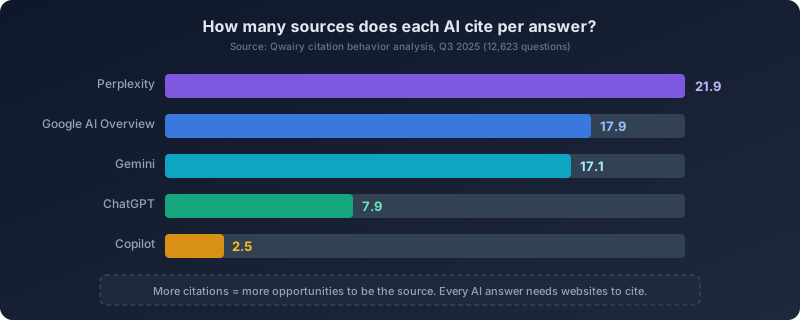
And it uses a lot of sources. A Q3 2025 analysis of 12,623 questions found that Perplexity averages 21.9 citations per answer. Google AI Overviews uses 17.9. Even ChatGPT, the most conservative, averages 7.9 citations. Every one of those citations is a website that showed up because its content was retrievable, authoritative, and well-structured enough to be worth citing.
What this means for how you write and structure content
Every paragraph is a candidate citation
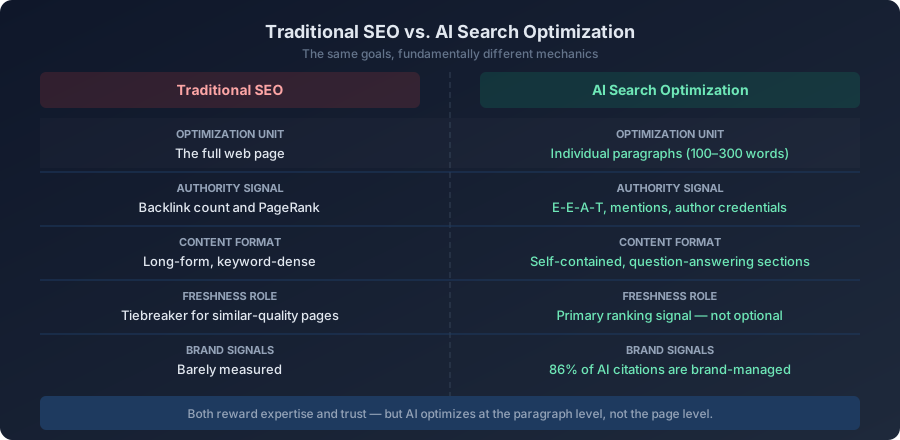
This is the mental shift that matters most. In traditional SEO, you wrote a page and tried to rank the page. In AI search, every section of your content is independently evaluated. A brilliant opening paragraph followed by twelve mediocre ones means you have one potential citation and twelve missed opportunities.
Each paragraph should work on its own. If an AI pulled just that paragraph, would it be a complete, accurate, useful answer? No "as mentioned above" references. No context dependencies. Self-contained units of information.
Authority is measured more broadly than backlinks
Backlinks still matter. The Semrush study confirmed a strong correlation between link quality and AI visibility. But AI systems also weigh signals that traditional SEO barely considered: how often your brand gets mentioned across the web, whether your content cites credible data, whether named authors with real credentials are attached to it, and how consistently other reputable sources reference your work.
A Yext study found that 86% of AI citations across Perplexity, ChatGPT, and Gemini come from brand-managed sources, meaning properties where the brand controls the content. Your website, your directory listings, your published articles. That is both a challenge and an opportunity: if you manage your brand presence well, you control most of what AI cites about you.
Freshness is not a tiebreaker, it is a primary signal
AI systems check dates aggressively. Perplexity in particular shows a strong recency bias, pulling nearly twice as many real-time sources as ChatGPT. A 2023 article competing against a 2026 article on the same topic will lose almost every retrieval, even if the older content is more comprehensive.
The fix is straightforward: update your key content regularly and make sure the modification dates are visible both on the page and in your Article schema.
Structure determines whether your content gets retrieved at all
Clear headings, question-answer formats, lists, and structured data make it easy for the retrieval system to identify and extract relevant passages. Content that meanders without clear section boundaries is harder to chunk and score, which means it gets passed over for content that is better organized.
Use questions as H2 headings. Put a direct answer immediately after. Then expand. This mirrors exactly how retrieval systems search: they look for passages that directly respond to a query.
A practical optimization framework
Based on how the RAG pipeline actually works, here is what to prioritize, in order:
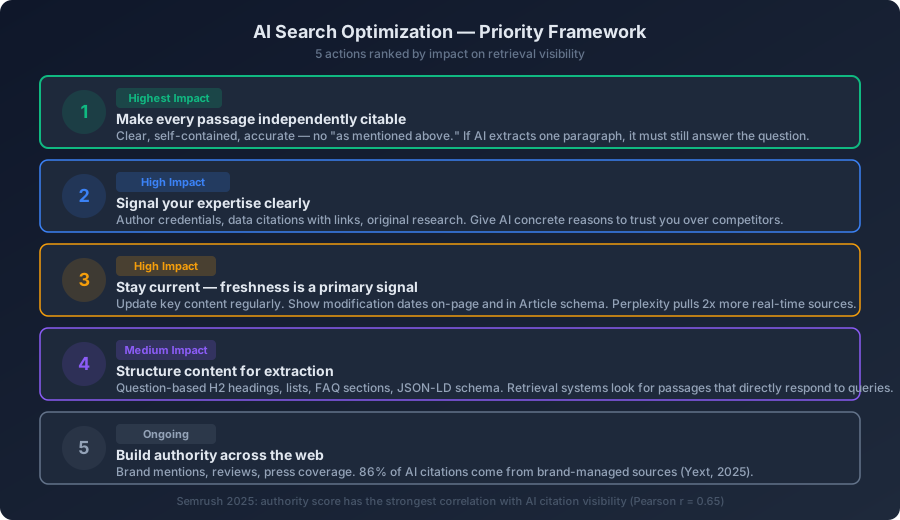
Make every passage independently citable. Clear, self-contained, accurate. This is the most impactful change you can make.
Signal your expertise. Author bios with credentials, data citations with links, original research. AI needs reasons to trust your content over the competition.
Stay current. Update content regularly. Show modification dates. Replace outdated statistics. AI will always prefer the newer source when relevance is close.
Structure for extraction. Question-based headings, lists, FAQ sections, JSON-LD schema markup. Make it easy for the retrieval system to find the right passage for the right query.
Build authority across the web. Brand mentions, reviews, social proof, press coverage. These signals tell AI that you are a trusted source in your space.
Want to see how your site scores against each of these? GenReady AI analyzes your website against the factors that RAG systems actually evaluate, and shows you exactly what to improve.