
Schema Markup for AI Search: The Definitive Implementation Guide
Structured data is the number one technical factor for AI search visibility, yet 87.6% of websites skip it. Here is exactly which schema types to implement, in priority order, with copy-paste JSON-LD examples.
Why structured data is the highest-impact technical change you can make
If you could only do one technical thing to improve your AI search visibility, it should be implementing structured data markup. Not because it is complicated (it is not), but because almost nobody does it and the payoff is disproportionate.
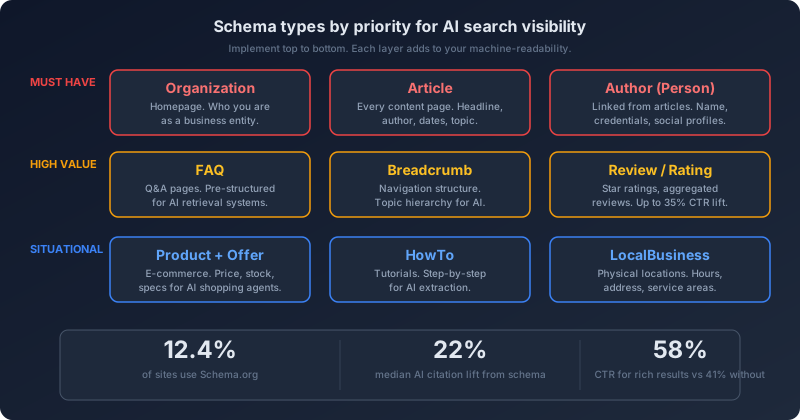
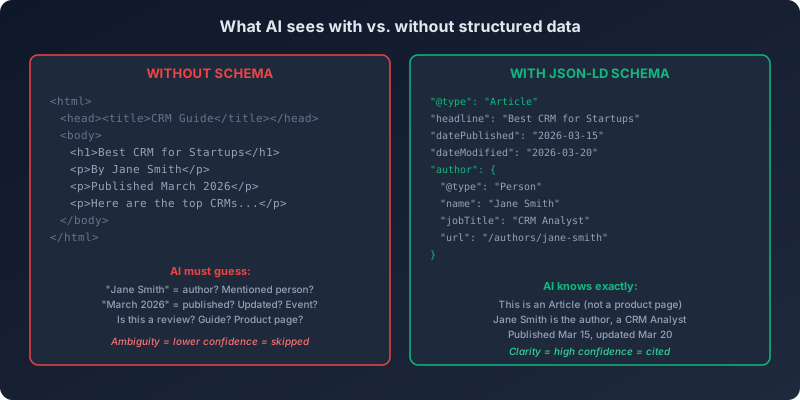
Only 12.4% of websites use Schema.org markup. That means 87.6% of the web makes AI crawlers guess what their content means: who wrote it, when it was published, whether it is an article or a product page or a recipe. AI systems can infer these things from context, but inference is unreliable. Explicit labels win.
A Relixir study found a median 22% lift in AI citations after implementing structured data. Pages with rich results get a 58% click-through rate versus 41% for pages without them (Milestone Research). The gap between "has schema" and "does not have schema" is one of the widest in technical SEO, and it is even wider in AI search.
Which schema types to implement first
Not all schema types matter equally for AI search. Here is the priority order, based on what AI retrieval systems actually use when evaluating sources.
Organization schema (homepage, must-have)
This tells AI systems who you are as a business entity. Your name, logo, contact information, social media profiles, founding date. It goes on your homepage and establishes your identity in AI knowledge graphs.
Without Organization schema, AI has to figure out your business details from scattered text across your pages. With it, you hand over a clean entity definition.
The JSON-LD looks like this:
{
  "@context": "https://schema.org",
  "@type": "Organization",
  "name": "Your Company",
  "url": "https://yoursite.com",
  "logo": "https://yoursite.com/logo.png",
  "sameAs": [
    "https://twitter.com/yourcompany",
    "https://linkedin.com/company/yourcompany"
  ],
  "contactPoint": {
    "@type": "ContactPoint",
    "email": "hello@yoursite.com",
    "contactType": "customer service"
  }
}
Article schema (every content page, must-have)
Article schema tells AI exactly what a piece of content is, who wrote it, and when. The two most important fields are datePublished and dateModified, because AI systems use these to assess content freshness. If your Article schema is missing the modification date, AI cannot tell whether your 2024 article was recently updated or has been stale for two years.
{
  "@context": "https://schema.org",
  "@type": "Article",
  "headline": "Your Article Title",
  "datePublished": "2026-03-15T09:00:00Z",
  "dateModified": "2026-03-20T14:30:00Z",
  "author": {
    "@type": "Person",
    "name": "Jane Smith",
    "jobTitle": "CRM Analyst",
    "url": "https://yoursite.com/authors/jane-smith"
  },
  "publisher": {
    "@type": "Organization",
    "name": "Your Company",
    "logo": {
      "@type": "ImageObject",
      "url": "https://yoursite.com/logo.png"
    }
  }
}
Author schema (linked from articles, must-have)
Author schema connects your content to a real person with real credentials. It feeds directly into E-E-A-T scoring, which is one of the strongest factors in AI source selection. Include the author’s name, job title, areas of expertise, social profiles (using sameAs), and a link to their author page on your site.
Websites with clear author expertise rank about 25% higher on average. Author schema makes those credentials machine-readable instead of just human-readable.
FAQ schema (high-value)
FAQ schema pre-structures your content in the exact question-answer format that AI retrieval systems prefer. Google deprecated FAQ rich results for traditional search in 2023, which made some people stop implementing it. That was a mistake.
FAQ schema still tells AI systems "this page contains questions and answers about X." That structure makes your content easier to chunk, easier to retrieve, and easier to cite. A seoClarity A/B test found roughly 25% traffic uplift from FAQ schema alone, scaling to 350% when combined with content optimization.
{
  "@context": "https://schema.org",
  "@type": "FAQPage",
  "mainEntity": [{
    "@type": "Question",
    "name": "What is the best CRM for startups?",
    "acceptedAnswer": {
      "@type": "Answer",
      "text": "For startups with under 10 people, HubSpot Free CRM and Pipedrive offer the best balance of features and simplicity. HubSpot is free up to 1,000 contacts; Pipedrive starts at $14/month with stronger pipeline visualization."
    }
  }]
}
Breadcrumb schema (high-value)
Breadcrumb schema tells AI how your content is organized hierarchically. If you have a page at /blog/crm/best-crm-startups, breadcrumb schema tells AI that this page belongs to the CRM category within your blog. That topical context helps AI understand what your site is authoritative about.
Review and rating schema (high-value)
Star ratings in search results increase click-through rates by up to 35%. For AI search, review schema also signals that your content or product has been evaluated by real users, which feeds into trust scoring.
Product + Offer schema (e-commerce)
If you sell products, this is not optional. AI shopping agents (Google Project Mariner, ChatGPT with tools, Perplexity Shopping) need structured product data to compare prices, check availability, and evaluate specifications. Without Product schema, your products are invisible to the agentic shopping web.
Include price, currency, availability, SKU, brand, reviews, and detailed descriptions. A retail case study found 20-30% CTR increase from product schema alone.
HowTo schema (tutorials and guides)
For instructional content, HowTo schema breaks your process into discrete steps that AI can extract and present. Note that Google deprecated HowTo rich results in late 2023, but like FAQ schema, the structured data still helps AI systems parse and cite your tutorial content.
Implementation: where to put it and how to validate
Use JSON-LD format. Google recommends it, and AI systems parse it most reliably. Place your JSON-LD in a <script type="application/ld+json"> tag in the <head> of your page, though anywhere in the HTML works.
Three rules:
Only mark up visible content. Do not add schema for things that do not appear on the page. AI systems cross-reference schema against page content, and mismatches hurt credibility.
Validate before deploying. Run every page through Google’s Rich Results Test and the Schema.org Validator. Broken schema sends incorrect signals, which is worse than no schema.
Keep it updated. Stale schema (wrong prices, old dates, former employees listed as authors) actively hurts your AI visibility. If you change your content, update the schema to match.
Common mistakes that kill your AI visibility
After auditing hundreds of websites, these are the errors I see most often:
Missing dateModified. This is the single most common mistake. AI systems use this field to assess freshness. Without it, your 2026 content looks the same age as your 2021 content.
Empty or generic author fields. Setting the author to "Admin" or leaving it blank destroys your E-E-A-T signal. Use real names linked to real author pages.
Schema on some pages but not others. Inconsistency tells AI that schema is an afterthought, not a standard. Implement it site-wide or not at all.
Using WordPress plugins without checking the output. Many schema plugins generate incomplete or incorrect markup. Always validate the actual output, not just the plugin settings.
Microdata format instead of JSON-LD. Microdata (inline HTML attributes) is harder for AI systems to parse and more prone to breaking when you redesign. JSON-LD is cleaner, separate from your HTML, and universally preferred.
How to audit what you have now
Before adding new schema, check what is already on your site. Open any page, view source, and search for application/ld+json. If nothing comes up, you have no JSON-LD schema on that page.
For a site-wide audit, GenReady AI scans every page and reports what schema is present, what is missing, and what is broken, with specific fix recommendations for each issue.