
Why AI Models Fail 76% of Real Tasks - And What This Means for Your Website
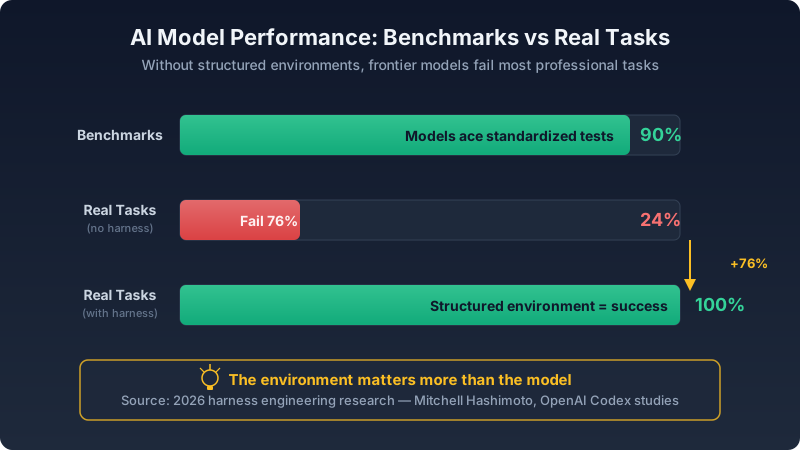
Frontier AI models score 90% on benchmarks but complete only 24% of real tasks without structured environments. The new 'harness engineering' methodology reveals why your website's structure matters more than which AI model visits it — and what OpenAI's $110B raise means for the agentic web.
The benchmark illusion
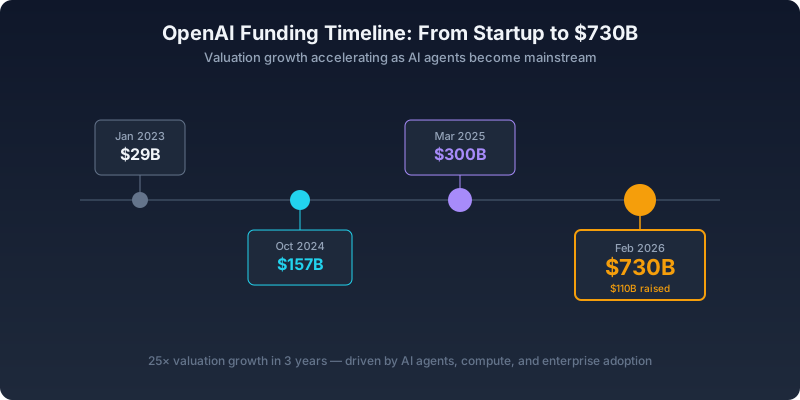
OpenAI just raised $110 billion at a $730 billion valuation. Amazon put in $50 billion. Nvidia committed $30 billion. The biggest private funding round in history, and almost every dollar is going to AI infrastructure compute, tools, and environments that make AI agents actually work.
Not better models. Infrastructure.
That distinction matters more than you'd think, especially if you run a website.
There's a stat making rounds in the AI engineering world this week that should make every website owner stop and think. Frontier AI models score around 90% on standardized benchmarks. Put those same models on real professional tasks without structured environments, and they complete only 24%.
That gap: 90% on tests, 24% on real work is the most important number in AI right now.
The finding comes from research around "harness engineering," a term Mitchell Hashimoto (co-founder of HashiCorp) coined and OpenAI's Codex team validated. The idea: wrap AI models in structured environments with constraints, tools, feedback loops, and clear context, and their success rate jumps to nearly 100%.
The model is the least important part of the stack. The harness is everything.
What is harness engineering?
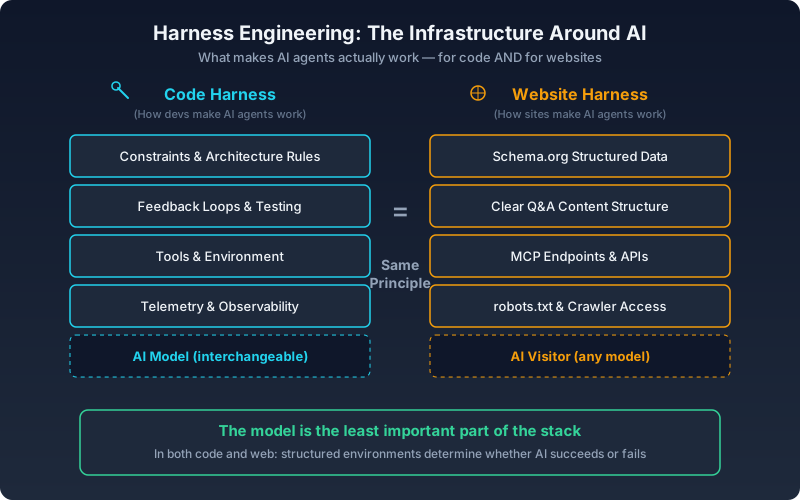
Harness engineering is a new software development methodology where humans stop writing code and start designing environments for AI agents. Instead of telling a model "write this function," you build a structured environment "a harness" that includes:
Constraints: architectural rules the AI must follow
Tools: linters, test suites, CI/CD pipelines the AI can use
Feedback loops: telemetry and observability so the AI can see what's working
Context: documentation, type definitions, and clear specifications
OpenAI reportedly built an entire million-line production codebase this way, with zero manually written code. Stripe's engineering team uses harnesses to let AI agents access 400+ internal tools. The pattern is spreading fast.
Your website is an AI harness (or it isn't)
Here's the part that applies to anyone with a website.
When an AI agent visits your site (a search crawler from Perplexity, a shopping agent from Google's Project Mariner, or ChatGPT answering a question using web sources) it faces the same problem as an AI coding agent facing an unstructured codebase. Messy, ambiguous, hard to navigate? The AI fails. Structured, labeled, clear? The AI succeeds.
Your website is either a good harness or a bad one. And as the coding research shows, this matters far more than which model is visiting.
Think about what AI agents encounter on most websites:
Content rendered by JavaScript that crawlers can't execute. They see a blank page.
No structured data, so the AI guesses whether "4.8" is a rating, a price, or a version number.
robots.txt files that block AI crawlers entirely. 71% of major sites do this.
Important answers buried deep instead of stated upfront.
No machine-readable interfaces for programmatic access.
That's a website without a harness. AI agents hit it and fail, just like coding agents fail on unstructured codebases.
Compare that to a site that has:
Server-side rendered HTML any crawler can read
Schema.org markup labeling every content type: Article, Author, Organization, FAQ, Product
Clear question-answer structure where every paragraph is self-contained and citable
MCP endpoints or APIs for programmatic interaction
Explicit crawler permissions in robots.txt
That's a website with a harness. The AI agent knows what it's looking at, extracts information reliably, and cites or interacts with your content accurately. Claude, GPT, Gemini, or a Chinese model running at 1/16th the price — they all succeed when the environment is structured.
The $110 billion context
The scale of OpenAI's raise tells you where this is heading.
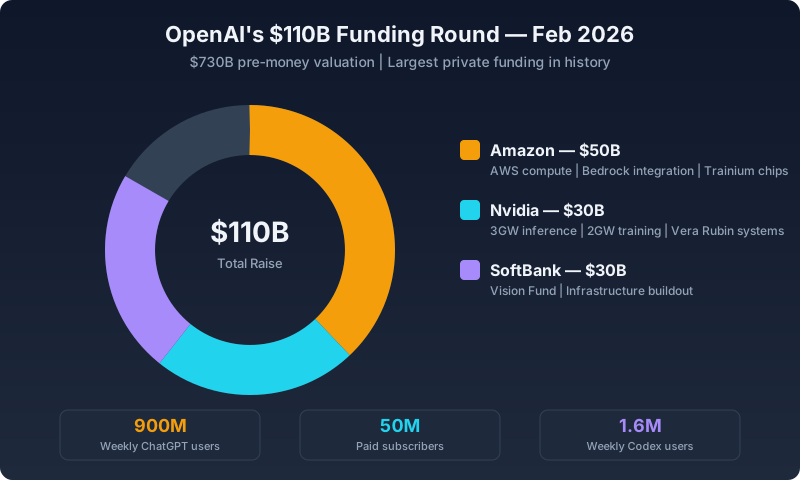
Amazon's $50 billion isn't charity. It's tied to milestones including deep Bedrock integration and custom models for Amazon products. Nvidia's $30 billion buys 3GW of dedicated inference and 2GW of training on next-gen Vera Rubin systems. This is infrastructure for running billions of AI agent queries every day.
ChatGPT already has 900 million weekly users. Codex has 1.6 million writing code through AI agents. Google's Project Mariner has 574,000 monthly active users browsing the web on their own. Those numbers only go up.
Every one of those agents will interact with websites. Whether they accurately represent your product, cite your content, or complete a transaction depends on whether your site gives them a structured environment to work with.
The practical parallels
The harness engineering research found specific things that make AI agents succeed or fail in code. Every one has a direct web parallel:
In code, architectural constraints prevent AI agents from making structural mistakes. On the web, Schema.org structured data tells AI exactly what your content means. No guessing.
In code, feedback loops let agents iterate. On the web, clear content with question headings and direct answers lets retrieval systems find the right passage for the right query on the first try.
In code, simplified tools outperform complex ones (the research showed simplifying interfaces boosted accuracy to 100%). On the web, clean server-rendered HTML beats JavaScript-heavy frameworks. If the AI can't parse your page, it moves to one it can.
In code, context matters more than model capability. On the web, well-structured content with author credentials, data citations, and clear metadata makes any AI model cite you accurately. The 12.4% of sites using Schema.org markup already outperform the other 87.6%.
What to do about it
Build your website's harness.
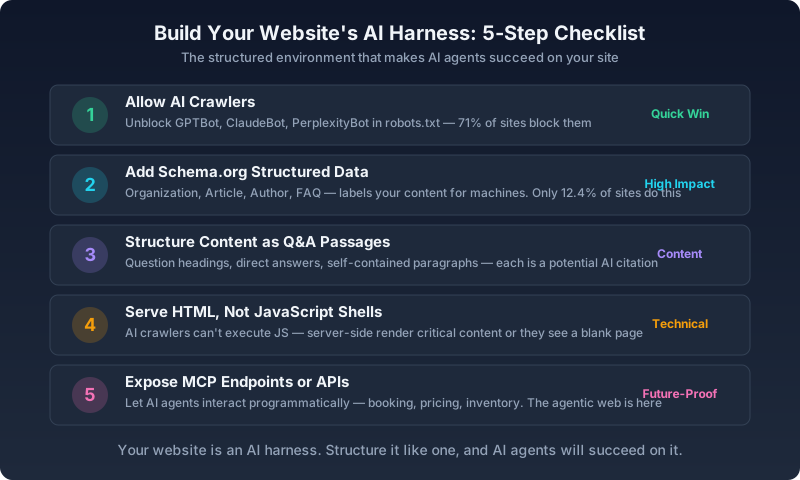
Allow AI crawlers. Check your robots.txt for blocks on GPTBot, ClaudeBot, PerplexityBot. If they can't read your site, nothing else matters. Five minutes.
Add structured data. Organization schema on your homepage. Article and Author schema on content pages. FAQ schema where you answer common questions. This turns ambiguous HTML into machine-readable information.
Structure content as passages. Questions as headings. Direct answers below. Self-contained paragraphs. AI retrieves passages, not pages. Each section is a potential citation or none at all.
Serve real HTML. If your content needs JavaScript to render, AI crawlers see nothing. Server-side rendering or static generation makes your content visible to every agent.
Expose machine interfaces. If your business offers services AI agents might use like booking, pricing, inventory, an MCP endpoint or API puts you on the agentic web. As agent costs drop, more of them will try to interact with your site programmatically.
The window
Harness engineering went from concept to mainstream practice in about six months. The same shift is coming for the web.
Most websites today are unstructured environments where AI agents fail. The ones that build proper harnesses like structured data, clear content, machine interfaces, will capture a disproportionate share of AI traffic, citations, and transactions.
The $110 billion OpenAI just raised will make AI agents faster, cheaper, and more numerous. The question isn't whether they'll interact with your website. It's whether your website gives them what they need to succeed when they do.
Want to know how well your website works as an AI harness? Try GenReady AI — it analyzes your site's structured data, content structure, and agent accessibility in under 60 seconds.