
Should Your Site Charge Agents?
AWS and Cloudflare now let you charge AI agents per request with x402. Real volume is still tiny. Who should pilot it, who should wait, and what to avoid.
For most sites, not yet. The pipes work: AWS and Cloudflare both let you charge AI agents per request, and a Linux Foundation project now governs the protocol behind it, x402. The money is the problem. Lifetime x402 volume is about $42 million, and October 2026 settled only $274,000.
The one group that should look at it now is anyone who already sells API calls or data per request. Everyone else should wait.
What is x402?
x402 is an open standard that lets any HTTP server charge for a request and lets any client, human or agent, pay in stablecoins. Coinbase open-sourced it in May 2025. The Linux Foundation took it over in April 2026 and launched the x402 Foundation on July 14 with 40 members, 17 of them premier: Visa, Mastercard, Stripe, Google, AWS, Cloudflare, Coinbase, American Express, the Solana Foundation, and others.
It reuses a status code that has been reserved since 1997. HTTP 402, "Payment Required," never had a standard behavior. x402 supplies one: the 402 response carries a price and payment instructions, the client pays on-chain, then retries with proof of payment.
x402 is the payment rail in the broader agent stack. For how it sits next to UCP, ACP, and AP2, see our agent readiness stack guide.
How does an x402 payment work?
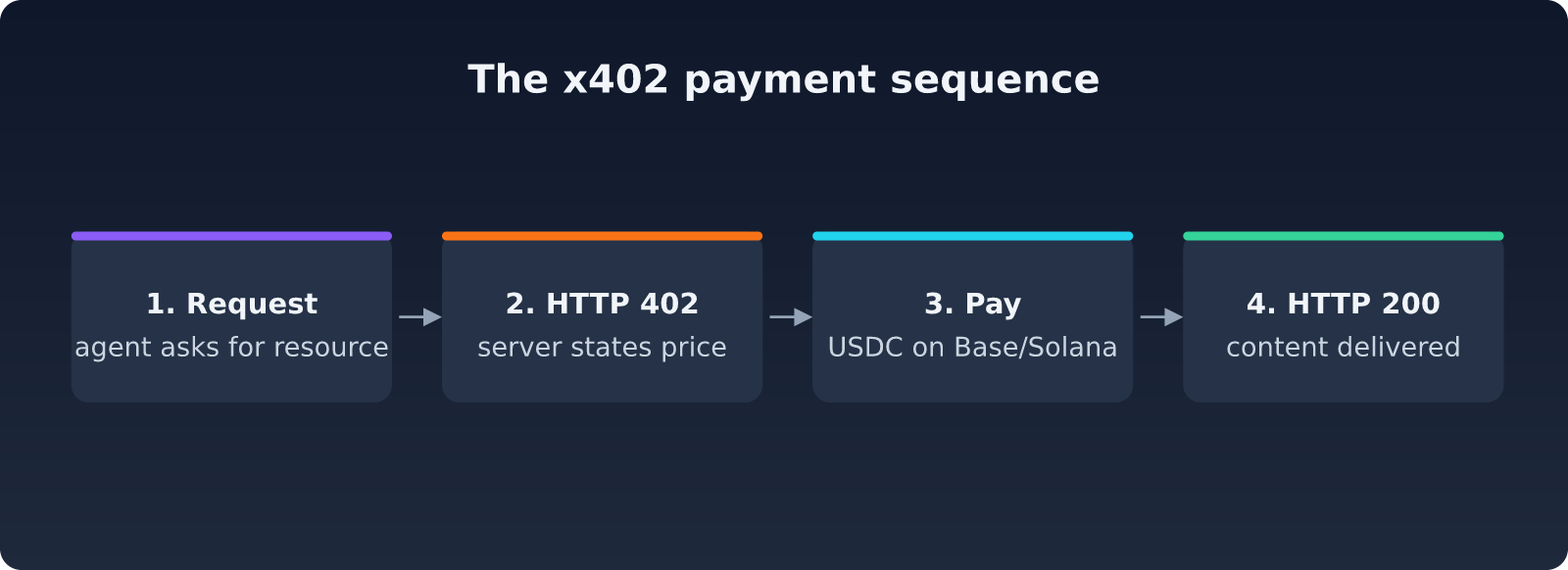
Four steps, all inside normal HTTP.
An agent requests your resource. Your server answers 402 with a price, say $0.005 for an API call. The agent pays in USDC, usually on Base or Solana, where fees are fractions of a cent and settlement takes about two seconds. It retries with the payment proof attached, and your server returns the content with a normal 200.
No account, no API key, no subscription, no card network. An agent can buy one request from a server it has never seen before.
Are agents actually paying?
Barely. This is the part the launch announcements skip.
The raw counts look huge. Trackers put x402 past 200 million transactions by the end of July, and Fireblocks counts 196 million across 12 chains as of November. But Fireblocks also puts total settled value at about $42 million since launch. The peak was November 2025, at $20.5 million. Monthly transactions have dropped 92% since December and sit at 4 to 6 million. October 2026 came to 5.1 million transactions worth $274,000.
The average payment is a few cents. Allium's Q3 data shows $3.7 million across 68.3 million payments, about five cents each. Over 87% of x402 payments fall between a hundredth of a cent and ten cents.
Much of the activity is not commerce. Artemis estimated in March that about half of x402 transactions were self-dealing or wash trading. After removing that, a Visa and Artemis analysis in August found about $19 million in adjusted volume. Forkast reports Artemis putting protocol signaling and testing above 95% of the activity. These estimates measure different things, so do not add them up. They agree on direction: the transaction count says little about demand.
I am not calling x402 a failure. The Q4 2025 spike was largely a meme-coin mint called PING, and the median wallet now makes its first payment 18 minutes after funding, down from 73 days in late 2025, per Chainalysis. Builders are using it. Paying customers are mostly not here yet.
How easy is it to start charging?
Easier than a year ago, and that is the real 2026 news.
AWS made x402 generally available in CloudFront and AWS WAF in mid-June, at no charge beyond standard WAF pricing. Your origin never touches a wallet. You set prices and collect USDC. On the buyer side, AWS shipped AgentCore Payments in August so agents built on Bedrock can pay.
Cloudflare is behind. Its Monetization Gateway opened a waitlist on July 1 for charging any resource behind Cloudflare via x402. As of today I found no pricing and no general availability date. Cloudflare's older Pay Per Crawl, which charges AI crawlers in fiat rather than stablecoins, is live and was adopted by Stack Overflow in February.
Outside those two, you add middleware. The open-source SDKs cover common Node and Python frameworks, and a facilitator service such as Coinbase's verifies payments on-chain and gives your server a yes or no. A route gains x402 in a few lines.
Which sites should charge agents?
It depends on what you sell.
Pilot it if you sell APIs, data, or per-call access. You already meter usage, and x402 lets an agent pay without signing up for a key. On AWS the pilot costs almost nothing. Pick one endpoint and price it at a few cents, since that is what agents are paying. Expect small revenue. The value is learning who calls you and what they will pay.
Wait if you publish content. Per-article micropayments work technically, but the buyers are thin and stablecoin settlement raises accounting questions for your finance team. If you want to charge AI crawlers at scale, Cloudflare's Pay Per Crawl is the more mature route today.
Skip it if you run a brochure site or a store. Nothing you sell is priced per request. Get cited and get agent-ready first. If you sell products, UCP is your protocol.
One warning for everyone. Do not put a paywall in front of the pages you want AI search engines to cite. A crawler that gets a 402 cannot quote you. Charge on API endpoints and datasets, not on the pages that earn you citations.
What are the risks?
Settlement is on-chain and final. A paid request does not guarantee that the right content arrived, and the protocol has no standard dispute process. If your pricing or delivery is wrong, you handle refunds yourself.
The standards picture is also unsettled. Fireblocks sees the market splitting: x402 for discrete web requests, session-based systems such as the Machine Payments Protocol for continuous, high-volume work. Google is wiring AP2 to work with x402 rather than compete with it, which helps. AP2 handles authorization of an agent spending a human's money, and x402 handles the per-request payment itself. Since April 28, AP2 sits with the FIDO Alliance.
How do agents find out you accept x402?
Through a discovery manifest at /.well-known/x402.json. It lists which of your resources are payable and at what price, so an agent can find paid endpoints without probing every URL. Publishers can also list endpoints on Coinbase's x402 Bazaar.
GenReady's analyzer checks for that manifest. Like all our agent readiness checks it is bonus-only: having it adds a point to your score, and missing it costs nothing.
Curious whether agents can pay you today? Run a free GenReady scan. It checks your x402 manifest and seven other agent readiness signals in under 60 seconds.