
Your FAQ Block Isn't Why AI Cites You: What 468,037 Citations Show
FAQ blocks and schema markup look like they win AI citations, but a University of Toronto study of 468,037 citations shows the effect vanishes inside one website. Here is what does move citations in 2026: question match, the engine's own search, dates and prices.
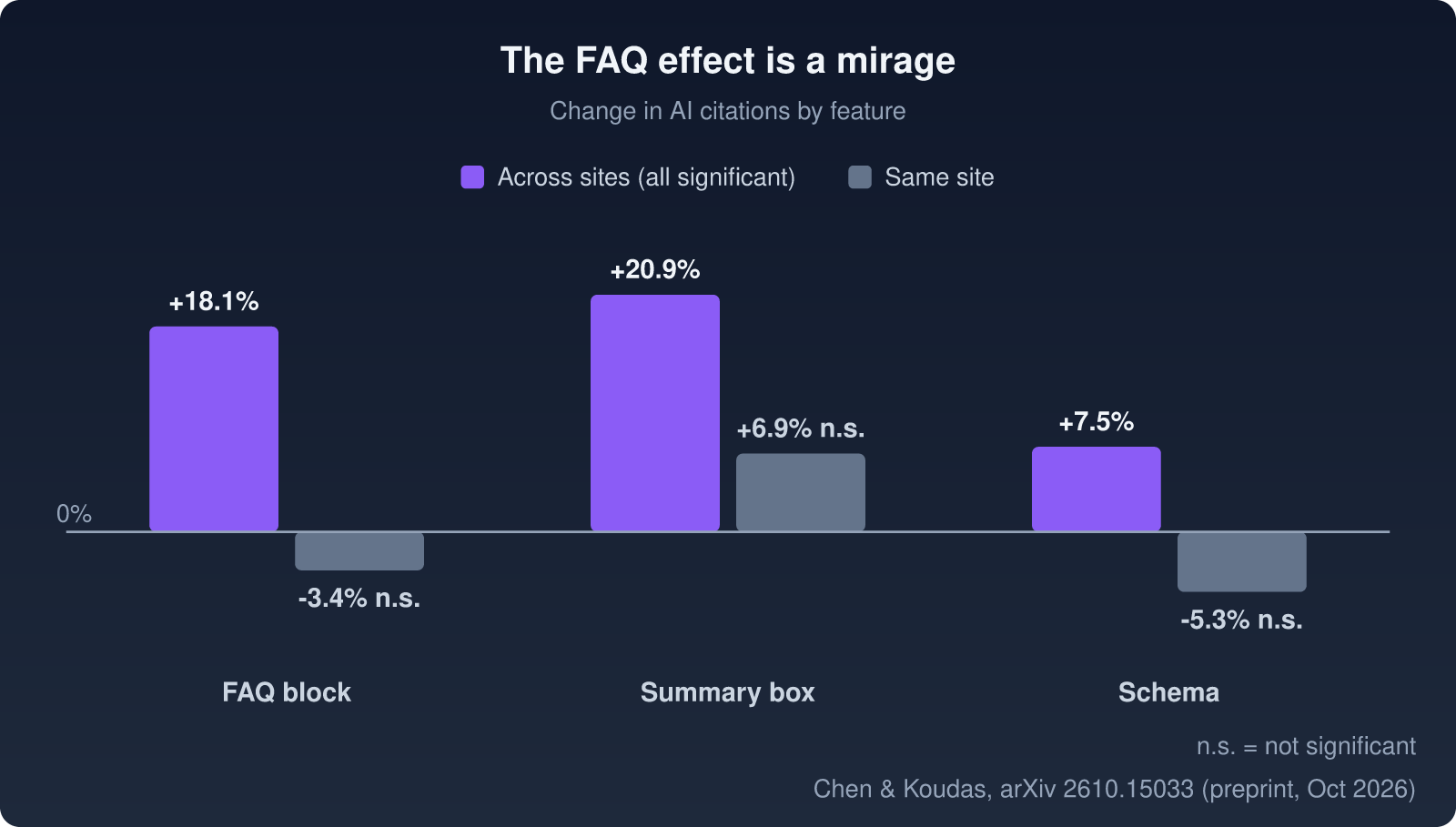
FAQ blocks and schema markup do not raise AI citations once you compare pages on the same website. In a University of Toronto study of 468,037 citations, FAQ pages looked 18.1% stronger across sites but scored −3.4% within a site, which is not significant. What does move citations is a title and paragraphs that answer the actual question.
Key takeaways
FAQ blocks, schema, summary boxes and author boxes show no significant effect within one site.
Adding JSON-LD did not lift ChatGPT or AI Mode citations in a 1,885-page test.
Pages whose title and best paragraph match the question get 14–16% more citations.
For ChatGPT, its own search explains 32% of the citation variation between pages of a site. Page features explain 2.8%.
Every number below was checked at the primary source on November 12, 2026.
Why do FAQ blocks look like they work?
Strong sites use FAQ blocks more, so the FAQ block gets their credit.
Mahe Chen and Nick Koudas (University of Toronto) collected 158,099 answers from ChatGPT, Gemini and Perplexity in 2026 (arXiv 2610.15033). FAQ blocks sit on 43% of pages at the most-cited quarter of websites. At the least-cited quarter, the figure is 23%.
Pool every page, and each practice they tested looks like a win. Compare pages inside one website, and none of them holds up. The authors call this Simpson's paradox.
Source: Chen & Koudas, University of Toronto, arXiv 2610.15033 (preprint, October 2026).
Does adding schema markup get you cited by AI?
Not in the best test so far.
Ahrefs tracked 1,885 pages that added JSON-LD against 4,000 matched control pages (Ahrefs, May 2026). After 30 days, the results were:
Google AI Mode: +2.4%, "statistically indistinguishable from zero"
ChatGPT: +2.2%, also indistinguishable from zero
Google AI Overviews: −4.6%, small but significant, cause unknown
Cited pages were "almost three times more likely to have JSON-LD." Track the same page before and after, and that lift is gone. Two study designs, same answer. On schema, that is the strongest signal I have seen.
The limits: every page already had 100 or more AI Overview citations, and the window was 30 days. Ahrefs also sells SEO tools. Keep schema for rich results and product data, but stop calling it citation work.
Do headings, lists and tables help AI cite a page?
No effect showed up in field data or in a lab test.
Within websites, Chen and Koudas found that "length, outbound links, headings, lists and tables show no effect." A Sprinklr team ran 252,000 two-page trials across six LLMs for SIGIR 2026 (arXiv 2605.25517). Formatting choices "had no impact."
That lab test never calls a search engine. Keep formatting for your human readers.
What does raise AI citations?
Inside one website, only question match clearly moved citations.
Every other page feature in the Toronto study sat near zero, which surprised me more than the FAQ result. The four levers below have the best 2026 support. None of them is a markup checkbox.
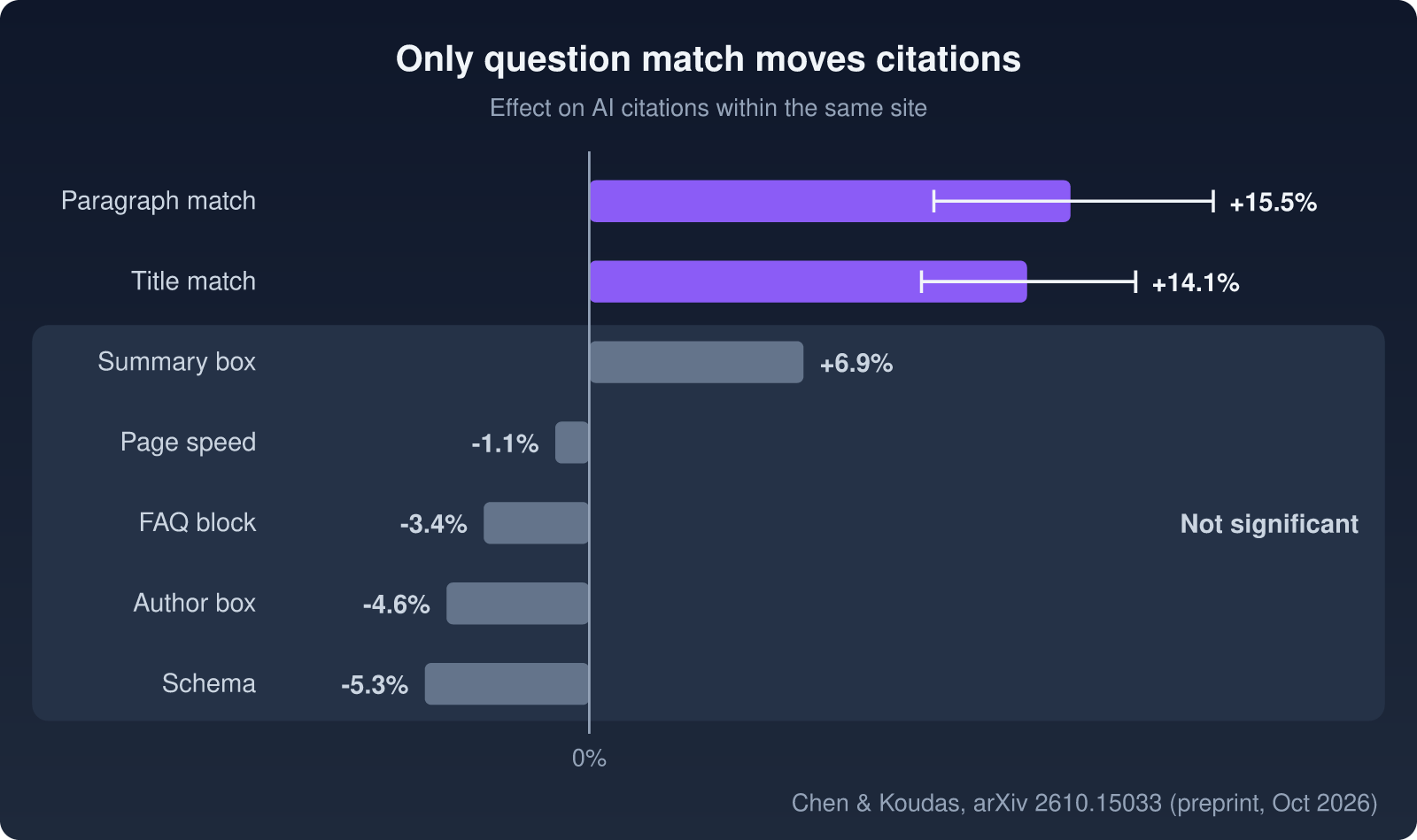
Source: Chen & Koudas, arXiv 2610.15033 (preprint). Match and speed effects are per one standard deviation.
Match the question in your title and paragraphs
A clearly better paragraph match went with 15.5% more citations (likely range 11.1% to 20.1%). A better title match went with 14.1% more. On third-party pages, such as review sites, the effects were 25.7% and 23.6%.
An FAQ section helps only if its questions are the ones buyers ask, in their words. The value sits in the answer text.
Get into the engine's own search
For ChatGPT, which pages its search retrieves "explains far more of the variation than page properties (32% against 2.8%)," comparing pages within the same site. That search is not Google's. Of the pages ChatGPT retrieved, 97% were missing from Google's top 50 for the answer's queries.
Domain strength still counts. Half of those pages (51%) came from websites that did rank in Google's top 50.
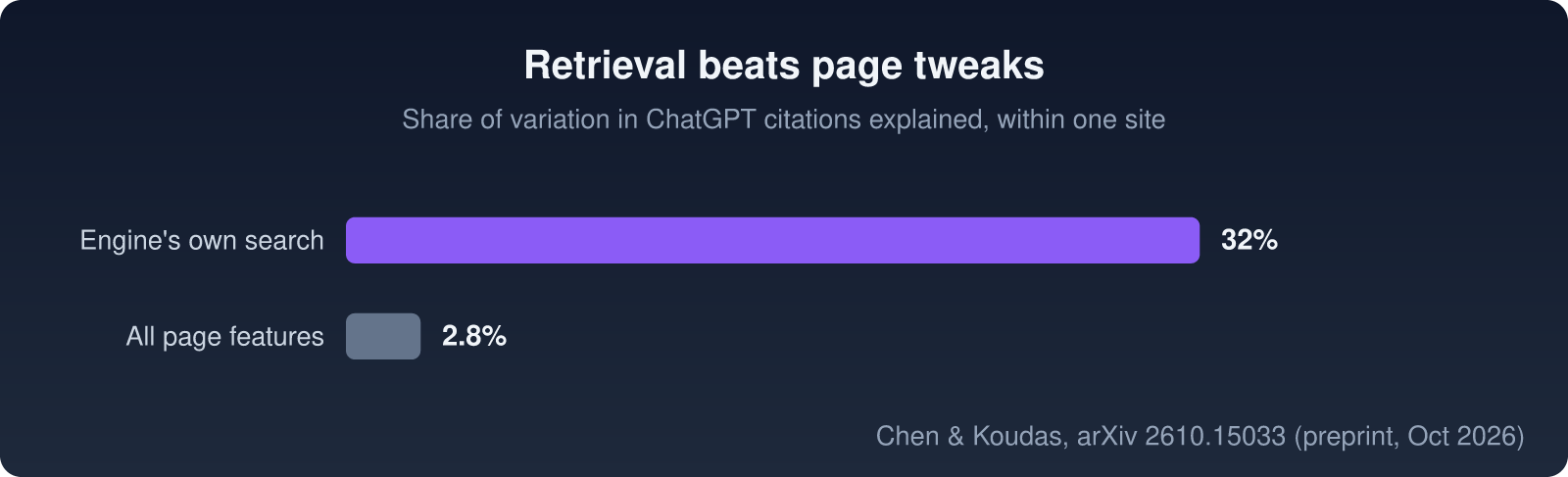
Source: Chen & Koudas, arXiv 2610.15033 (preprint, October 2026).
Show dates and prices
In the SIGIR test, a recent timestamp and a stated price were two of four "gatekeepers." All six models almost always picked the dated, priced version.
Do not refresh every date by reflex. In the Toronto data, older pages got 5.1% fewer citations per standard deviation of age, but not consistently. Dates matter most on topics that change.
Do not block Google-Extended by default
Riley Grossman and colleagues studied 11,500 queries for SIGIR 2026 (arXiv 2604.27790). Sites that block the Google-Extended token were "significantly less likely to be retrieved by AIOs." All 21 popular publishers that Gemini never cited block it.
This is an association from one December 2025 collection. Google pitches the token as a Gemini training opt-out. If you block it, do it on purpose.
Does rewriting content with an LLM help?
It backfired in the only full-pipeline test.
SAGEO Arena (KDD 2026, arXiv 2602.12187) ran a search pipeline over 171,003 web documents. LLM rewrites of body text "consistently" lowered visibility. The worst method dropped pages 22.35 positions.
Edits to titles, headings and JSON-LD raised retrieval hits by 22%. But that pipeline reads those fields by design, so it says nothing about Google or OpenAI.
The evidence at a glance
Tactic2026 evidenceSourceFAQ block+18.1% across sites, −3.4% within (n.s.)Chen & KoudasSchema / JSON-LD−5.3% within (n.s.); no lift after adding itChen & Koudas; AhrefsHeadings, lists, tablesNo effectChen & Koudas; SIGIRLLM body rewriteWorse at every stageKDD 2026Title, paragraph match+14.1%, +15.5%Chen & KoudasEngine retrieval (ChatGPT)32% of variation vs 2.8%Chen & KoudasRecent date, stated pricePicked almost every timeSIGIR 2026Blocking Google-ExtendedLess AIO retrievalSIGIR 2026
How strong is this evidence?
It is the best evidence so far, not the final word.
Chen and Koudas: a new preprint, not yet replicated. It used API models in two commercial markets. Perplexity cited nothing in 95.8% of answers, and the authors call the results "associations."
Ahrefs: a vendor study of pages engines already cited.
SIGIR and KDD papers: lab setups, not live engines.
What persuades me is the agreement. Three different study designs reach the same answer.
What should you do instead?
Start with the content:
Rewrite titles to match the question a buyer would ask.
Answer in the first paragraph, in the buyer's words.
State prices, specs and key numbers in plain HTML text.
Date time-sensitive pages, and update them when facts change.
Skip LLM "GEO rewrites" of your body text.
Then check access and measurement:
Review robots.txt for Google-Extended and other AI crawlers.
Serve AI crawlers a real page, not a block, login wall or empty JavaScript shell.
Keep schema for rich results and product data.
Compare similar pages on your own site, and track changes for several weeks.
FAQ
Should I remove FAQ schema or FAQ sections?
No. The within-site effect was −3.4% and not significant, so there is no sign they hurt. Keep FAQ sections that answer real questions.
Does llms.txt help AI citations?
Nobody knows yet. No 2026 study I could find measures its effect on citations.
Do these findings apply to every AI engine?
Mostly. Paragraph match helped on all three engines in the Toronto data. Title match helped on Gemini (+16.8%) but not on ChatGPT (−0.2%), which rewrites questions into its own searches.
GenReady checks the parts of this research you control: whether AI crawlers can reach your pages, and whether your content answers real questions. Run a free scan at genready.ai.