
Three Ways to Let AI Agents Operate Your Site: MCP Server, WebMCP, or NLWeb?
An MCP server reaches every MCP client and 32,980 servers are already registered. WebMCP now reaches four agent surfaces, but Safari has formally objected. NLWeb has not shipped code since June. How to pick, and when to combine them.
Three protocols compete to be the way agents use your site's functionality, and they are not interchangeable. An MCP server reaches every MCP client. WebMCP now reaches four agent surfaces, up from one in July, and Apple has formally objected to it. NLWeb has not shipped a code change since June 10.
If you can build one of them this quarter, this comparison decides which. Short answer: the MCP server, in most cases. Here is the long answer.
Status verified September 17, 2026.
What are the three options?
All three sit in the interaction layer of the agent readiness stack. They let agents do things on your site instead of only reading it.
An MCP server runs next to your backend. It exposes tools, such as search, create, and update, to any client that speaks the Model Context Protocol. Browsers are not involved. Agents connect straight to it. The public MCP registry listed 32,980 servers when we counted them on September 17, 2026.
WebMCP puts the tools inside the page. Your JavaScript registers functions, and a browsing agent calls them while the user browses. It is a W3C Community Group draft, which means an early proposal with no standards body committed to it yet.
NLWeb turns your content into a question-answering service. You run an /ask endpoint that returns schema.org JSON, plus an /mcp endpoint. It is the only one of the three that runs retrieval on your side, meaning it searches your own content to find the passages that answer a question.
How do they compare?
Reach should drive the decision, and it is still not close. MCP clients ship inside the tools your users already run, including Claude, ChatGPT, Copilot, and Cursor. WebMCP reaches four agent surfaces, and two of them are trials with expiry dates on them. NLWeb's audience never arrived.
When is each the right choice?
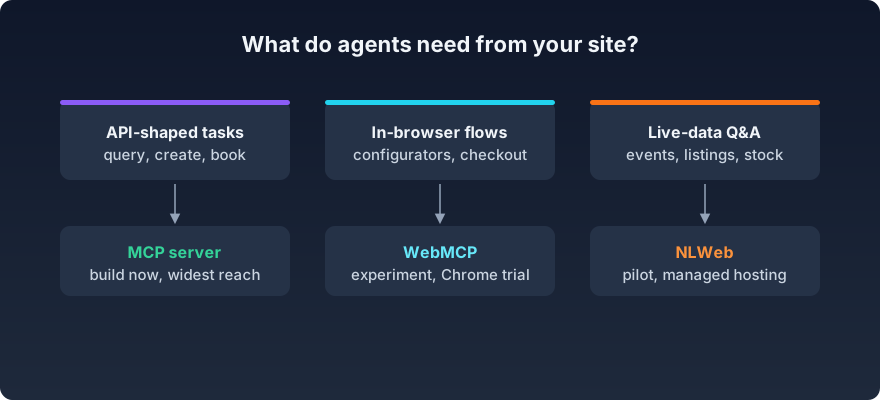
Build the MCP server when the tasks agents want from you look like API calls. Query the catalog. File the ticket. Book the slot. Pull the report. That covers most SaaS products, most marketplaces, and most data products. It works today, and the Agent Skills ecosystem reinforces it. Forty-six products now read the Skills format, and a skill is the cheapest way to teach an agent to use your server well.
Add WebMCP when your value lives in the browser session itself. Think configurators, multi-step checkouts, and tools where state piles up on the client. This is the call that changed since July. ChatGPT's desktop browser reads your tools with no token, so the work pays off outside a trial now. Keep the build small anyway. Browsers without support ignore your registrations, and Safari's objection means you should not plan on support everywhere.
Pilot NLWeb only when your problem is conversational search over live data, and stale third-party indexes visibly fail your users. Events, listings, and inventory qualify. Take Cloudflare's managed path, called AutoRAG until its rename to AI Search, rather than self-hosting. That integration is still labelled public preview. Measure query volume before you renew the spend.
Can you combine them?
Yes, and the combinations beat the either-or framing.
The MCP server is the foundation. The other two are additive. WebMCP tools can wrap the same backend functions your MCP server exposes, so the second build is cheap once the first exists. NLWeb's /mcp endpoint lands you in the MCP ecosystem anyway.
The order that works: ship the MCP server on the 2026-07-28 spec now, add a skill to guide agents next, add WebMCP tools for your top browser flow if consumer traffic matters to you, and add NLWeb only if demand shows up in your logs.
Do not build all three at once, and do not build any of them before the cheap layers. Schema.org and markdown negotiation improve every agent interaction, including the ones these protocols enable.
GenReady's analyzer detects all three: WebMCP declarations in your pages, NLWeb /ask endpoints, and MCP server cards. All three are bonus-only checks. They add points and never subtract.
Not sure which interaction layer your site already has? Run a free GenReady scan — it checks all three in under 60 seconds.