
What is NLWeb and should your site implement it?
Microsoft's NLWeb gives any site an /ask endpoint that answers questions from live data. Adoption stalled anyway. Why it happened, what would change it, and who should still pilot one.
Microsoft launched NLWeb at Build 2025 with a big pitch: any website could answer natural-language questions directly, no search engine in the middle. Shopify, TripAdvisor, Eventbrite, O'Reilly, and Hearst properties signed on early. Then adoption flattened, and it has stayed flat into mid-2026.
NLWeb is the most ambitious protocol in the agent readiness stack and, right now, the hardest to recommend. Here is what it does, why it stalled, and what would change the answer.
Status verified July 12, 2026.
What is NLWeb?
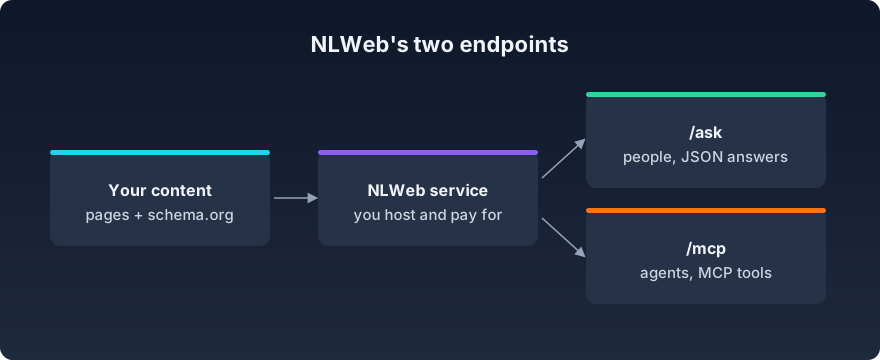
NLWeb is an open protocol that gives your website two endpoints. The /ask endpoint takes a natural-language question, in JSON over REST, and answers it with structured schema.org results drawn from your own content. The /mcp endpoint exposes the same capability as an MCP server, so AI agents can query your site programmatically, on terms you control.
Microsoft introduced it at Build 2025 as an open project, pitching it as "HTML for the agentic web": a thin standard that turns any site into an AI-queryable app.
The control argument is real. When an AI assistant answers questions about your content from its own index, you get whatever it scraped, whenever it scraped it. An /ask endpoint answers from your live data, shaped how you want.
How does it work under the hood?
NLWeb is a small retrieval service you run. It ingests your content, leaning heavily on your existing schema.org markup and feeds, embeds it into a vector store, and uses a model to answer questions against it, returning schema.org-shaped JSON rather than prose.
That "you run" clause is the catch. A live NLWeb endpoint means hosting a retrieval pipeline, paying model inference on every query, and keeping the index fresh. It is a product, not a file. Compare that with the rest of the stack: llms.txt is a text file, an agent card is a JSON document, markdown negotiation is a conditional in your server.
Cloudflare's AutoRAG integration is the main effort to shrink that cost, offering a managed path where Cloudflare hosts the pipeline. It is the most practical route in if you want one.
Why did adoption stall?
Three reasons show up consistently.
The cost-to-demand ratio is bad for most sites. Running inference on your own dime makes sense when many users ask your site questions. Most sites never saw that demand materialize, because users ask their assistant, not your website.
The ecosystem consolidated elsewhere. Agents standardized on MCP for tool access, and NLWeb's /mcp endpoint became its most defensible feature: a way to be one MCP server among many rather than a new consumer behavior.
And no major assistant committed to preferring NLWeb endpoints. Without a consumer of /ask at scale, publishers had little reason to run one, and without publishers, assistants had little reason to commit. Classic protocol standoff.
The early adopter list is still the launch list: Shopify, TripAdvisor, Eventbrite, O'Reilly, Hearst titles like Delish, Chicago Public Media, Common Sense Media. Impressive names, short list, and it has not grown much in a year.
What would change the verdict?
Watch for three signals. A Build 2026 recommitment with real distribution, meaning Copilot or Bing routing user questions to NLWeb endpoints. Managed hosting becoming default-cheap, which is the Cloudflare AutoRAG trajectory. Or a large vertical, travel or e-commerce, standardizing on /ask for live availability queries where stale indexes genuinely fail.
Any of those would move NLWeb from "watch" to "worth adding" for sites in the affected category. We track this in the agent readiness stack guide, which we update as statuses move.
Should your site implement NLWeb now?
For most sites, no. The cost is real, the consumer demand is not, and the same effort spent on schema.org and markdown negotiation pays off with every AI system instead of one endpoint few agents call.
Consider it if you fit a narrow profile: a large, structured, fast-changing catalog, think events, listings, or inventory, where answers must come from live data, plus existing schema.org discipline, plus infrastructure appetite. The Cloudflare AutoRAG path makes a pilot reasonable there.
If you want the agent-facing half without the retrieval product, run a plain MCP server instead. You keep the programmatic access story and skip the inference bill. Our full comparison of the three interaction protocols publishes later in this series and walks through that choice.
GenReady's analyzer probes for a working NLWeb /ask endpoint on every scan. It is a bonus-only check: having one adds a point, missing one costs nothing.
Want to know which interaction protocols make sense for your site before building any of them? Run a free GenReady scan — results in under 60 seconds.