
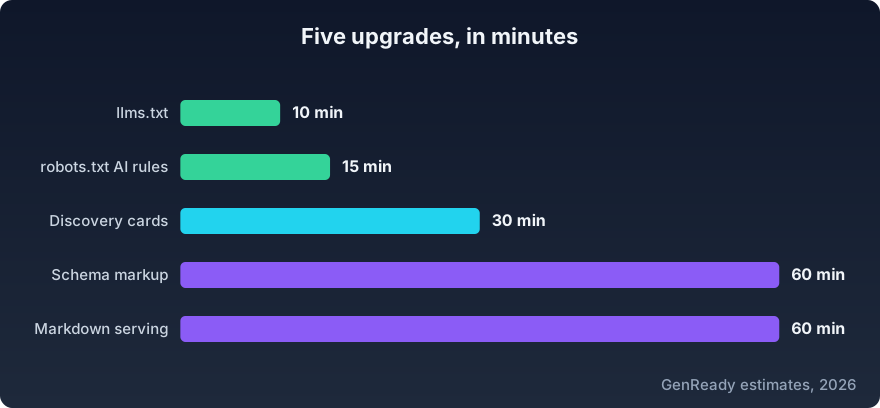
Agent Readiness in an Afternoon: Five Upgrades of an Hour or Less
About three hours of work covers the agent readiness fundamentals for a typical site: robots.txt AI rules, llms.txt, schema markup, markdown serving, and discovery cards. The checklist, with verification steps.
Most of agent readiness is not a project. Of the 17 protocols in the stack, the ones that matter for a typical site come down to five upgrades, none longer than an hour, and two of them under 15 minutes. Total: about three hours, including verification.
This is the checklist version. Each upgrade says what it does, how to do it, and how to prove it worked.
Current as of July 12, 2026. The llms.txt step was updated August 19, 2026 for the v2 spec.
1. Set your AI rules in robots.txt (15 minutes)
What it does: tells AI crawlers what they may use your content for, before any other protocol matters. Without explicit rules you are opted in to everything by default.
How: add user-agent blocks for the AI crawlers you want to allow or block (GPTBot, ClaudeBot, Google-Extended, PerplexityBot, CCBot). If you are on Cloudflare, review the AI crawler controls in your dashboard too; from September 15, 2026, new-customer defaults change to allow search but block training and agent use on ad-carrying pages.
Verify: fetch yourdomain.com/robots.txt and read it as an AI company would. Every major AI crawler's name should hit an explicit rule.
2. Add llms.txt (10 minutes)
What it does: less for citations than you have heard. The evidence for citation gains is null. What it does do is give coding agents a map of your documentation, which is why OpenAI, Anthropic, and Google all publish one for their own developer docs. It also forces you to decide which ten pages matter most.
How: create a markdown file at /llms.txt following the structure the spec fixes, in this order. An H1 with your site name, which is the only required part. A blockquote holding a one-line summary. Then H2 sections, each containing a markdown list of - [Page name](url): what it covers. Point those links at markdown versions of your pages rather than the HTML, because since the August 2026 revision that is the spec's central expectation.
Then spend two of your ten minutes on discovery, which v2 added. Advertise the file with rel="describedby" and your markdown pages with rel="alternate" type="text/markdown", either as <link> elements or an HTTP Link: header, so agents stop guessing.
Verify: fetch it. If picking the page list took you longer than ten minutes, that was the actually valuable part.
3. Add schema.org markup to your key pages (60 minutes)
What it does: the highest-impact hour in agent readiness. Structured data is how AI systems confirm what your page is, and it feeds everything from citations to UCP product discovery.
How: pick the schema type that matches your site: Article for posts, Product for listings, FAQPage for support content, LocalBusiness for a service site. Add JSON-LD to your templates rather than hand-editing pages, so every new page inherits it. Our schema implementation guide has the full walkthrough.
Verify: run your key pages through Google's Rich Results Test, then confirm the JSON-LD parses.
4. Serve markdown to agents that ask (60 minutes)
What it does: cuts the token cost of reading your pages by 70-90% for agents that send Accept: text/markdown, which Claude Code and OpenCode already do. This is the upgrade that answers a request agents are literally making.
How: if you are behind Cloudflare or on a docs platform, it may be a toggle; check first. Otherwise add a conditional to your routes that returns the markdown source when the header asks for it.
Verify: curl -H "Accept: text/markdown" https://yourdomain.com/your-page and confirm you get markdown, not HTML with a relabeled header.
5. Publish your discovery cards, if you have something to discover (30 minutes)
What it does: makes your MCP server or agent findable from your domain in one request. Only applies if you run one; a card pointing at nothing is worse than no card.
How: MCP server card at /.well-known/mcp/server-card.json, A2A card at /.well-known/agent-card.json.
Verify: fetch both URLs and run the JSON through a validator. Stale endpoints and trailing commas are the two classic breakages.
What you deliberately skipped
Everything else in the stack is a Watch for a typical site right now: WebMCP is one browser's origin trial, NLWeb needs infrastructure demand you probably lack, and the commerce protocols only matter if you sell. The decision matrix covers when each graduates to your to-do list.
That is the honest shape of agent readiness in 2026: three hours of fundamentals now, a quarterly check on the rest.
Prove the afternoon worked
Scan your site before you start and after you finish. GenReady checks the markdown negotiation, the discovery cards, and the rest of the agent readiness signals, scores them as bonus points, and shows exactly which upgrades registered.
Start with the before-scan: genready.ai — under 60 seconds, and you'll have the after-scan to compare by dinner.