
Which Agent Readiness Protocols Does Your Site Actually Need? The Adopt/Watch/Skip Matrix
Seventeen protocols, five site types, one matrix. Updated September 2026: WebMCP is already live on every Shopify storefront, llms.txt lost its last Adopt cell, and x402 volume fell 93%.
Seventeen protocols now claim a place in your agent readiness roadmap, and adopting all of them would be a mistake for every site type we scan. The right list depends on what your site is: a blog needs three moves, an API business needs five different ones, and a local service site needs almost none of it.
This is the decision matrix. Find your row, do the Adopt column, calendar the Watch column, and ignore the rest with a clear conscience. Background on every protocol lives in the full stack guide.
Verdicts current as of September 2, 2026. Three moved since the July edition: WebMCP, llms.txt, and x402.
The matrix
| Protocol | Blog / content | Docs / SaaS | E-commerce | API / data | Local business |
|---|---|---|---|---|---|
| schema.org | Adopt | Adopt | Adopt | Adopt | Adopt |
| Markdown negotiation | Adopt | Adopt | Adopt | Adopt | Watch |
| robots.txt AI rules | Adopt | Adopt | Adopt | Adopt | Adopt |
| llms.txt | Cheap extra | Cheap extra | Skip | Cheap extra | Skip |
| RSL licensing | Watch | Skip | Skip | Watch | Skip |
| MCP server + card | Skip | Adopt | Watch | Adopt | Skip |
| A2A agent card | Skip | Watch | Skip | Watch | Skip |
| Agent Skills | Skip | Adopt | Watch | Adopt | Skip |
| WebMCP | Skip | Pilot | Audit now | Skip | Skip |
| NLWeb | Skip | Skip | Watch | Watch | Skip |
| UCP | Skip | Skip | Adopt | Skip | Skip |
| ACP | Skip | Skip | Consider | Skip | Skip |
| x402 | Skip | Skip | Skip | Watch | Skip |
Six verdicts appear in that table. Adopt means do it now. Audit now means it may already be running on your site without you switching it on, so go and look. Pilot means run a bounded test, not a rollout. Consider means the answer depends on your own numbers. Cheap extra means low cost and unproven benefit. Skip means ignore it.
Web Bot Auth is missing from the table on purpose. Agent identity verification happens at your CDN or host, so there is still nothing for a site owner to install. Its standing did improve on September 1, 2026, when the IETF working group adopted draft-ietf-webbotauth-httpsig-protocol-00 on the standards track and the older individual draft expired. Watch your CDN's changelog, not your own codebase.
Three verdicts moved since July. WebMCP went from a browser experiment to something already switched on for a large slice of the web. llms.txt lost its one Adopt cell after a 300,000-domain study found no citation effect. And x402 fell out of the Pilot column entirely, which I did not expect to be writing.
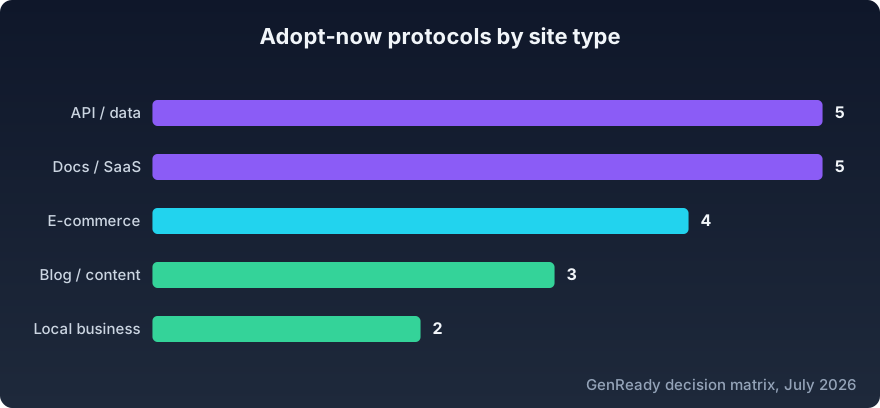
Count the Adopt cells and the shape is unchanged. API, data and SaaS sites tie for the longest list at five. Local businesses get away with two.
Blog or content site: three moves
Your visitors increasingly include agents reading on a budget. Adopt schema.org Article, FAQ and Person markup, markdown negotiation, and explicit AI rules in robots.txt so crawlers know your terms. Our schema implementation guide covers the first one, and how AI crawlers read your website covers why the other two matter.
Two dates belong on your calendar. Cloudflare flips Content Signals defaults for new domains on September 15, 2026: search allowed, training blocked, agent use blocked on pages carrying ads, plus a new use= field. Treat that as a nudge to write your own robots rules rather than inherit someone else's. Note the caveat, though. Google's John Mueller said on July 6, 2026 that Content Signals has "no effects whatsoever for any crawler or llm."
llms.txt drops to Cheap extra here and everywhere. SE Ranking studied roughly 300,000 domains and found 10.13% adoption and no measurable effect on citations. Removing the file from their model actually improved its accuracy. The v2 revision shipped August 10, 2026 and is a better spec, but a better spec for something nobody has shown works. Publish one if it costs you an hour. Do not publish one instead of markdown negotiation.
Watch RSL if your archive has licensing value. Roughly 1,500 media organizations have endorsed it, Reddit and Yahoo among them, and it is how smaller publishers will express pay-for-training terms. Skip the interaction and commerce layers entirely. An agent does not need to operate a blog. It needs to read and cite it.
Docs site or SaaS product: the interaction stack pays here
Everything from the blog row applies, and then the real work starts. Adopt an MCP server with a server card, plus Agent Skills that teach agents your product. Agent Skills now run in 46 compatible clients, including ChatGPT, Codex, Gemini CLI, Copilot and Cursor, which is the broadest reach of anything in this table.
One warning on the MCP row. The July 28, 2026 revision was the largest the spec has had. The core is stateless now, the initialize handshake and Mcp-Session-Id are gone, routing moved into headers, and roots, sampling and logging are deprecated on a twelve-month clock. Build against the new spec. A server written to last year's shape is a migration you have already scheduled without meaning to.
llms.txt loses its Adopt cell here, and this was the row it held. The argument was always that coding agents fetching documentation are the use case it serves, which is why OpenAI, Anthropic and Google each publish one for their developer docs. That mechanism is real and still unmeasured, and the only study at scale came back negative. v2 lets the file cover a subpath, so /docs/llms.txt indexes your documentation without touching the site root. Ship it in the hour it takes. Do not count it as readiness work.
WebMCP moves from Watch to Pilot if your product has browser-heavy flows, because the cost of trying collapsed. Cloudflare made it one dashboard toggle for any site behind its network on August 6, 2026. That is worth an afternoon on a staging origin. It is not worth custom engineering while the spec sits in a W3C Community Group draft and only Chromium ships it.
Watch an A2A card if you expose an agent of your own. That spec reached 1.0 with cryptographically signed agent cards and joined the Agentic AI Foundation on August 17, 2026, so the standard is settling even though your reason to publish a card has not changed. NLWeb stays a skip: your MCP server already gives agents programmatic access.
E-commerce: WebMCP is already on, go look at it
If you run Shopify, WebMCP was never a decision you got to make. Since August 5, 2026 every Liquid storefront exposes ten tools to in-browser agents: catalog search, store browse, product and variant lookup, cart read and write, cart cancel, checkout, order management and policy search. No app, no theme edit, no admin toggle, and no announcement. Hydrogen storefronts get the same set in developer preview. Cloudflare shipped an equivalent the next day for any site behind its network, though there it is a toggle you flip rather than a default.
So the July advice to watch WebMCP until it leaves origin trial was wrong for a large share of stores, and I would rather say that plainly than quietly change a table cell. Go and read what your storefront already tells an agent it can do. Read your product copy and your policy pages as tool output, because that is now what they are. Then check the limits.
WebMCP is Chromium only, on the Chrome 149 to 156 origin trial, against a W3C WebML Community Group draft revised July 28, 2026 that is not on the standards track. Firefox and Safari have shipped nothing. Our WebMCP guide has the implementation detail for stores that are not on a platform doing it for them.
The rest of the row is steadier. Adopt schema.org Product markup, markdown negotiation, robots rules, and UCP, which is on by default if you run Shopify. UCP passed 16,171 verified stores on August 31, 2026, up from about 8,000 in mid-June, and Amazon, Meta, Microsoft, Salesforce and Stripe joined its Tech Council on April 24. Then run the ACP math: it costs about 7.2% all-in against roughly 3.2% for UCP, it is still beta on an April 17, 2026 snapshot, and merchants running both protocols report up to 40% more agentic traffic. Add it when ChatGPT referrals and your margins justify the spread.
Watch NLWeb for live-inventory search. Skip x402. Your products are not priced per request, and the payment rail had a bad quarter.
API or data business: five moves, minus the payments
You are the site type agents pay, in theory. Adopt schema.org, markdown negotiation, robots rules, an MCP server with card, and Agent Skills. That is five, tied with SaaS for the longest Adopt column in the table.
x402 comes out of the Pilot column. Settlement volume is down roughly 93% since January by analyst Jamie Coutts' count, from late-2025 peaks near $800,000 a day to a seven-day average around $41,800 in late August. Worse, a population-scale study of 136.7 million Base settlements between September 2025 and June 2026 found 21.20% provably self-dealing and 63.78% inside funding-linked operator clusters, leaving 15.02% that might be arm's-length commerce. Of 25,163 advertised resources on Base, 624 ever received a payment and 249 ever earned ten dollars.
The infrastructure got better while the demand got worse. AWS CloudFront reached GA in July 2026, Cloudflare's Monetization Gateway left the waitlist on July 1, and the x402 Foundation now runs 40 members under the Linux Foundation. None of that changes the odds for any specific API business. Two hundred and forty-nine sites out of 25,163 ever cleared ten dollars. That is not a pilot. That is a lottery ticket. Watch it. Revisit if arm's-length volume grows rather than total volume.
Watch A2A cards if you ship agents, RSL if your data has licensing value beyond per-call access, and NLWeb if natural-language querying suits your dataset.
Local business: keep it small
Adopt schema.org LocalBusiness markup and clean robots rules. That is genuinely most of it. Your customers' agents need your hours, services, address and booking link, all of which JSON-LD carries.
The July prediction here held. Local businesses get the agent layer through their platforms rather than their own code. Google announced at I/O in May 2026 that agentic booking would expand to local experiences and services, rolling out across the US over the summer, and for home repair, beauty and pet care Search will call businesses on a user's behalf. You did not implement a protocol for that. Your listing data and your booking provider did.
Watch markdown negotiation if your site has substantial content. One exception to the Skip column: hospitality. Google opened a waitlist for UCP for Lodging, which extends the commerce protocol to direct hotel booking. Specs are still listed as coming soon, so it is a calendar item and not a project.
How to use this without overbuilding
Two rules keep the matrix honest. First, finish your Adopt column before touching your Watch column. Every row's Adopt items are cheap, proven, or both, and the Watch items are neither yet.
Second, re-check quarterly, because a verdict can go stale between editions in either direction. WebMCP went from Watch to already running on your storefront in a single Tuesday changelog entry with no announcement. x402 went from a reasonable pilot to a rail carrying mostly its own operators' money. This edition changed three cells in seven weeks. The next one will change others.
GenReady's scan covers the checkable protocols in this matrix and tells you which cells you already pass. When we ran it against the web's top 500 domains, one passed. If you want the fastest route through your Adopt column, start with the five upgrades of an hour or less.
Find your gaps in under 60 seconds: run a free GenReady scan and see which of your Adopt column is already done.